How to Opt Out of TikTok's AI Training
 Dan Saltman13 min read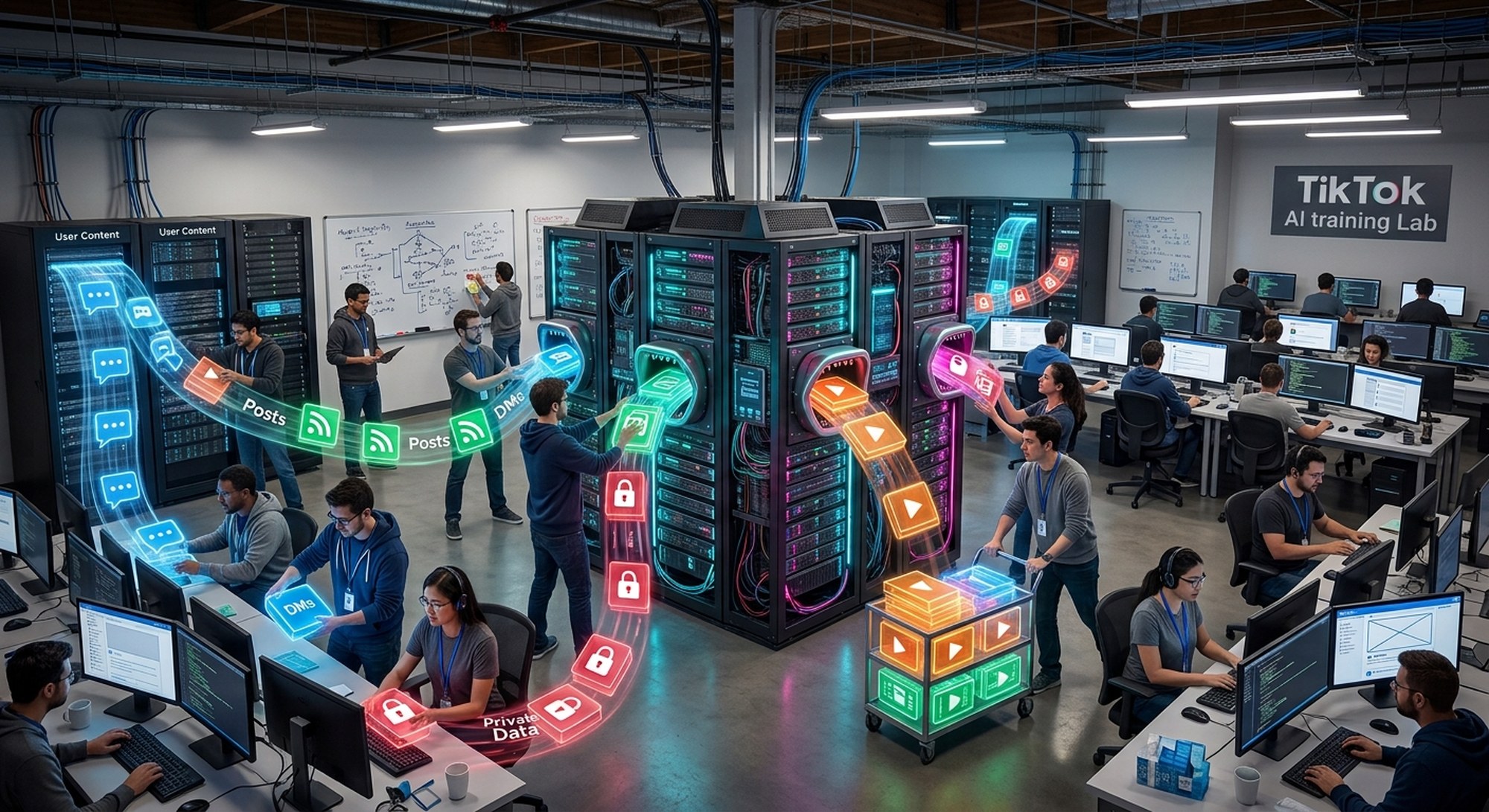
On this page
On TikTok, there's no easy on/off switch for sharing your data for AI training. Instead of one opt-out toggle, TikTok spreads the controls across video settings and a legal form, which makes opting out painful.
TikTok's US privacy policy, in the version that took effect on 15 July 2026, says it uses what it collects to "train, test, and improve technology, such as machine learning models and algorithms," including by "scanning, analyzing, and reviewing user content, messages, AI interactions," and nothing in the site settings lets you say no to it. Separately, it says TikTok may collect user content "at the time of creation, import, or upload, regardless of whether you choose to save or publish" it. The examples it gives for that are recommending audio, effects and captions, not training, but nothing in the policy keeps those clips out of the training clause either.
That means that clips you've filmed and left sitting in your drafts can still end up on TikTok's servers.
How to Stop AI Training As Best You Can
TikTok doesn't say whether or not it trains on your drafts. It collects them regardless, so the careful assumption is that anything TikTok holds could end up in a training set. That leaves you two options, and neither is a real opt-out. The one per-video switch that named AI, for AI remixing, was pulled weeks after it launched, and what's left in each video's settings covers reuse, not training. Deleting takes your content off TikTok, but TikTok doesn't promise to drop copies it already holds. This guide walks both, in that order, because together they're still the most you can do.
Option One: Lock Down Each Video's Permissions
Open any video you've posted, and behind its ... menu is a Privacy settings panel. The setting that matters there is Reuse of content, which covers Duets, Stitches and stickers. Turn it off and tap Done, and other people can no longer build their own posts out of that clip.
To be clear: that stops people reusing your clips, but it doesn't name AI and it isn't a training opt-out. TikTok doesn't say whether it has any effect on training. There's no account-wide version of this setting, so if you have hundreds of clips, you'll need to disable the setting for all of them, one by one.
Doing that by hand is exactly the slog TikTok is counting on you to give up on. Redact revokes reuse permission in one pass. On the Videos tab, switch the operation from delete to revoke permissions. Every video the run matches stays on your profile, while other people lose the right to reuse it. If your version of the app still offers an AI remix option, leave it off, because TikTok removed that control and there's nothing left for Redact to switch off.
None of this touches the training clause in the policy, though. That's where option two comes in.
Option Two: Delete What You've Posted
Deleting a video takes it off TikTok and off your profile for good, and that's the whole logic of option two. It doesn't wait on TikTok agreeing to anything, but it isn't a recall. The US terms give TikTok a licence over what you've submitted that they call "non-exclusive, irrevocable, and royalty-free", and deleting a video means TikTok stops displaying it publicly rather than handing that licence back. Nothing in the terms says a copy TikTok already holds is kept out of future training. Of course, this option isn't the greatest if you're an up-and-coming content creator, but it's the most you can do on your own.
Assuming you're not an aspiring content creator and just want to nuke all of your content, be ready for a slog. TikTok makes mass deletion deliberately slow. There's no select-all, so a five-year account means opening each clip, tapping the menu, confirming the delete, and doing it again a few hundred times or more, depending on how much content you've generated.
How to automate the mass deletion of your TikTok content
Say hello to Redact! Redact (that's us) does all the clicking for you in one pass, and the filters mean you don't have to take the whole account down to get the sensitive part out. You can narrow a run by date range, by view count, or to public or private uploads only.
- 1
Connect TikTok in Redact
Download Redact, add TikTok, and sign in through the window it opens. Redact picks up the session itself and doesn't keep your password.
- 2
Clear your videos, with a filter or without
On the Videos tab, leave the filters open for a full wipe, or narrow it by date range, view count, or public against private. Turn on Protect Pinned Videos to keep anything pinned to your profile. Run Preview first. It lists every video the run would touch and deletes nothing.
TTikTokAction *
Delete, or revoke sharing permissions
Delete videosRevoke permissionsPrivacy *
Public or private videos
Public videosPrivate videosDate Range
Only delete videos in this window
Jan 2022Dec 2024View Count
Filter by min and max views
Min 0Max 1,000Protect Pinned VideosRedact's TikTok Videos form: a date range, a view-count band, the public and private filter, and Preview to list the matches before anything is deleted. - 3
Don't forget the private ones
This is the step most people skip. Set the privacy filter to Private and Redact clears every video you hid rather than deleted. They're the clips most people assume are already safe. Full walkthrough in Delete all private videos on TikTok.
TTikTokPrivacy *
Only delete private videos
Public videosPrivate videosDate Range
Only delete videos in this window
Any timeTodayThe same form with the privacy filter set to Private, so only hidden videos are queued and public uploads stay put. - 4
Then likes and reposts
Both are content TikTok holds against your account. Likes are on their own tab, covered in Delete all your liked videos. Reposts are covered in Delete all TikTok reposts.
- 5
Comments? You have to do those by hand
Redact doesn't currently offer TikTok comment deletion, and TikTok has no bulk tool for your comments either. Its bulk option, up to 100 at a time, only covers comments other people made on your posts. Your own go one at a time. Open the post, tap the Comments button on the side, press and hold your comment, then tap Delete, which is the route TikTok documents. It's slow, so start with anything that names a place, a person, or a job, and work back.
- 6
Deal with the drafts on your phone
Redact can't reach drafts, because they live in the app on your device. Open Profile, tap the Drafts tile, and delete them. The policy says TikTok may have collected them already, so this stops the next one rather than recalling the last, but it's the only place that footage can be cleared from.
Deleting has limits. A model that already trained on a piece of your content keeps whatever it learned, and TikTok's terms don't say a copy it still holds is kept out of the next training run either. The licence survives the delete, and TikTok's own terms say your content stays publicly accessible where someone else has built a post out of it, so a video someone downloaded or stitched is theirs now and no deletion on your side can call it back. Delete to take your content off the platform, and don't count on it emptying what TikTok already holds.
If You're in the EEA, UK or Switzerland
TikTok's right-to-object page gives users in the EEA, the UK and Switzerland a legal right to object. In the EEA that right comes from GDPR, in the UK from the UK's own version of it, and in Switzerland from its Federal Act on Data Protection. It also only covers processing TikTok carries out for its legitimate interests or for a task in the public interest, and the page points to the legal bases section of its privacy policy for which basis covers what. To use it, choose "Make an objection to the processing of my data" and name the processing you're objecting to, which in this case is the use of your content to train machine learning models. TikTok says it weighs "the reasonable expectations you may have" and "whether there are less privacy intrusive means that achieve the same purpose" before it decides.
It's the only formal route TikTok offers, and it's a request rather than a switch. It's also the slowest thing in this guide. In May 2026, Surfshark's research team picked ten social platforms and counted the actions each one takes to opt out of AI training, where an action is a tap, a form field, or a consent toggle. The chart below shows nine, because the tenth, Kwai, wasn't available in Surfshark's region to test. TikTok came out worst of the platforms that offer anything at all.
What it takes to opt out of AI training, platform by platform
TikTok
19 only where a data protection law appliesFacebook
8 no promise outside the EU and UKInstagram
8 no promise outside the EU and UKSnapchat
3 to 5LinkedIn
3 to 5Twitter
3 to 5Pinterest
3 to 5Reddit
No option no opt-out existsDiscord
No option says it doesn't train on user data
Nineteen actions, and TikTok's page only names those three places. The form itself is TikTok's privacy request form, which takes a submission from anywhere, so you can still send one wherever you live. Privacy laws in some other countries give a similar right to object, so check yours before you write. Where no law gives you that right, TikTok is under no obligation to weigh the request.
Why a Private TikTok Account Won't Help You
Going private is the setting most people reach for, and it's worth having. In the app it's Profile, the Menu button, Settings and privacy, then Privacy, and Private account is the first switch. Approve your followers and only they can watch your videos and lives, read your bio or see your likes, and nobody can Duet, Stitch, make stickers from or download what you post. If you're 13 to 15, TikTok has done it for you since January 2021.
What a private account covers
Stops people, not TikTokStops
- Strangers watching, downloading or reposting your videos
- Scrapers that copy public TikTok video into third-party AI datasets
- Duets, Stitches and stickers made from your videos
- People-search and face-search sites indexing your videos
Doesn't stop
- TikTok's own use of your videos, including for training models
- Videos you set to "Only you", which stay on TikTok's servers
- Drafts and clips you never posted, which the policy says can be collected anyway
- Your messages and your chats with TikTok's AI features
A private account keeps your videos out of the datasets other AI companies scrape from public TikTok. The right column isn't a gap in the setting, it's what the setting was never for. "Private" on TikTok has always meant private from other users, and TikTok is not another user.
Surfshark found the same thing. Most platforms say they train on public content, while TikTok, Pinterest and LinkedIn reserve the right to use private data as well, and TikTok "reportedly analyzes not only public videos but also private videos and even unsaved drafts for AI training." That's the study's reading rather than TikTok's confession, but it matches a policy that never draws a line between the two.
Keep It From Filling Back Up
If you're going to keep posting, the honest setup is all of it at once. The per-video switches and a private account handle what other people and other companies can do. A standing deletion keeps what's on TikTok small.
Scheduled deletion runs the same filters on a timer, so anything older than a window you choose is gone without you opening the app. A 30-day window means a video does its job and leaves.
Questions People Ask
FAQ
Does making my TikTok account private stop TikTok training AI on my videos?
No. Private controls other users, not TikTok. TikTok's policy says it collects user content at the time of creation, import or upload whether or not you publish it, and it uses what it collects to train machine learning models. Deleting takes your content off TikTok, though TikTok doesn't promise to drop copies it already holds.
Can TikTok see videos I set to private or Only you?
They sit on TikTok's servers the same as a public upload. Surfshark's May 2026 study puts TikTok among the platforms that reserve the right to use private data as well as public.
Is there a TikTok AI opt-out switch?
There isn't one in any region. In the EEA, UK and Switzerland, local privacy law lets you object through TikTok's right-to-object form, which Surfshark counted at 19 actions, though the right only covers processing TikTok bases on its legitimate interests or the public interest. Anyone else can submit the same privacy form. Some other countries' privacy laws give a similar right, and where none applies TikTok is under no obligation to act on the request.
Does deleting my videos remove them from a model that already trained on them?
No. A trained model keeps what it learned. Deleting takes a video off the platform, but TikTok's terms don't promise a copy it already holds is kept out of future training either.
What about drafts I never posted?
The policy covers them, because collection can happen at the moment a clip is created. Drafts live in the app on your device, so clearing them is something you do on the phone rather than in Redact.
To recap: TikTok has no AI training opt-out, and it pulled the one AI switch it had. Turning off reuse stops other people, a private account stops strangers and scrapers, and deleting takes your content off the platform. The objection form is a legal right only in the EEA, UK and Switzerland. None of it comes with a promise that TikTok keeps your content out of training.