How to Lock Down Your Privacy Settings on DeviantArt
 Dan Saltman5 min read
- Last verified
- August 13, 2026
- Not working?
- Let us know
- Difficulty
- Easy
- Time required
- 4 to 7 minutes
Direct links to your DeviantArt privacy settings
Four settings on four separate pages, so these links save more time than on any other guide here.
- My accountThis is where you stop showing your birthday on your public profile.
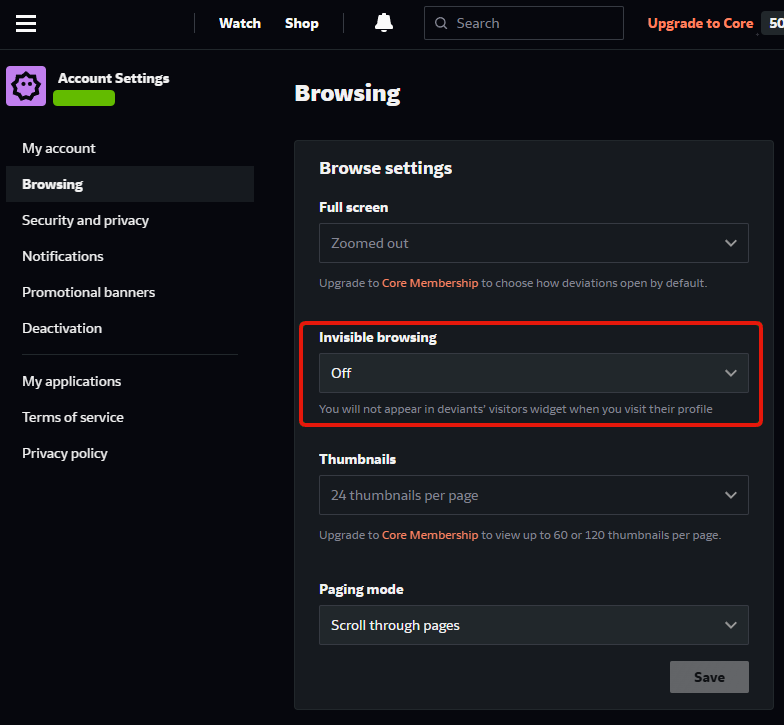
- BrowsingThis is where you turn on invisible browsing, so you stop appearing in other people's visitor lists.
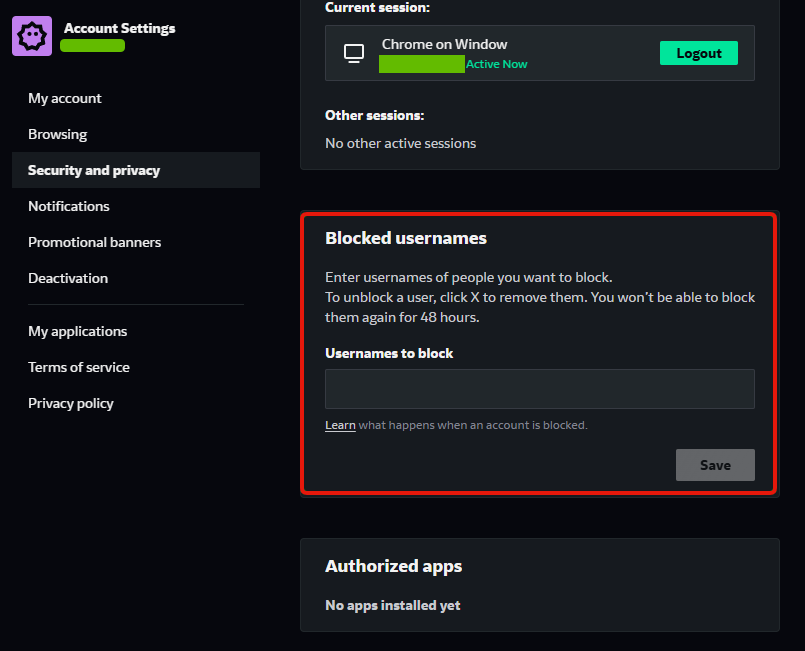
- Security and privacyThis is where you block specific accounts from reaching you, and check which devices are signed in.
- Personal dataThis is where you download a copy of everything DeviantArt holds on you, or permanently delete it. Hidden: it only joins the settings menu once you are on it.
The AI control is not in your account settings
None of the four settings below stops your work being used to train a model, and the one thing in settings with AI on it is a filter for not seeing AI-generated art, which does nothing about your own art.
The control that does exist sits on your deviations. DeviantArt's help centre calls it the NoAI
label, a flag that "unambiguously communicates that artwork with this flag is not authorized for
inclusion in third-party datasets for training AI models". You set it one deviation at a time on the
submit or edit page, and in bulk from your Studio or your gallery, where applying it to the All
gallery covers everything you've posted. Where it's on, the deviation page carries noimageai in
its robots meta tag, which is the part a scraper reads.
That's a request rather than a fence. It announces that your work is off limits and then depends on whoever is collecting to honour it. Check yours is on, and treat it as the weaker half of the job.
What your account settings do have is four genuine privacy settings, spread across four pages. The last doesn't join the settings menu until you're on it.
1. Hide your birthday
Go to My account and find Personal information. The Birthday display dropdown defaults to Show only month and day publicly.
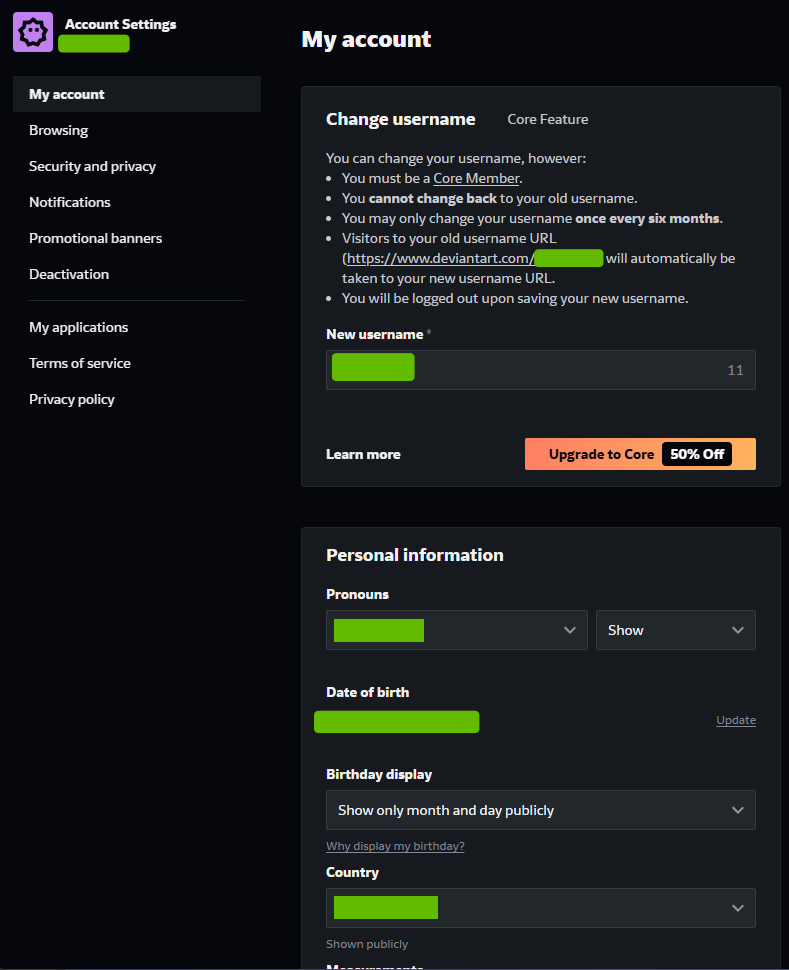
Change it to the private option and press Save.
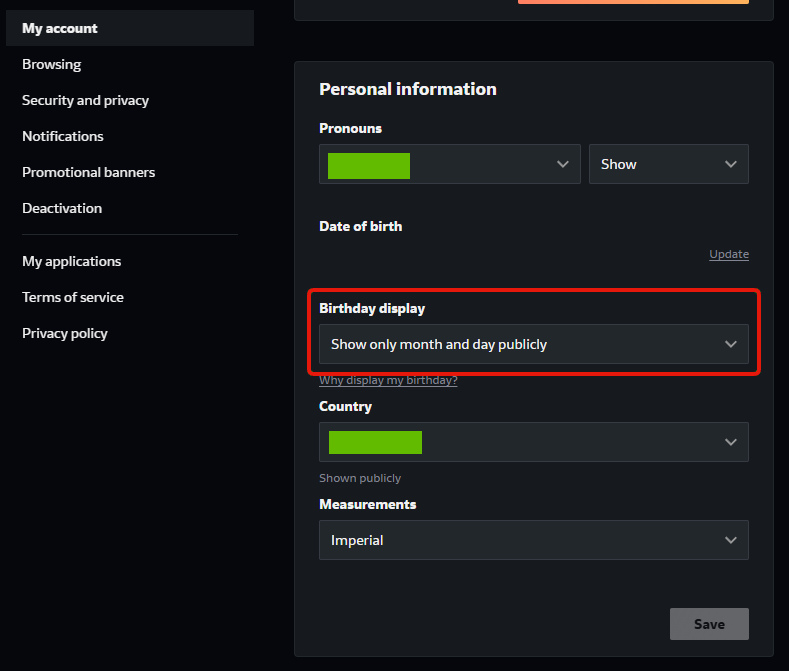
A birthday, even without the year, is one of the standard fields used to match a username to a real person. Country sits just below it and is marked Shown publicly too.
2. Turn on invisible browsing
Go to Browsing, set Invisible browsing to On, and press Save. Until you do, every profile you look at records that you were there.
3. Block anyone you do not want on your profile
Go to Security and privacy and use Blocked usernames. DeviantArt says that once you unblock someone, you can't block them again for 48 hours. The same page lists your active sessions, worth a glance for anything you do not recognise.
4. Request or delete your personal data
Go to Personal data. You can't reach this page from the settings menu. It only joins the menu once you're already on it, which is why the four shots above have no Personal data entry and the one below does. The route DeviantArt gives you is a link in the privacy policy.
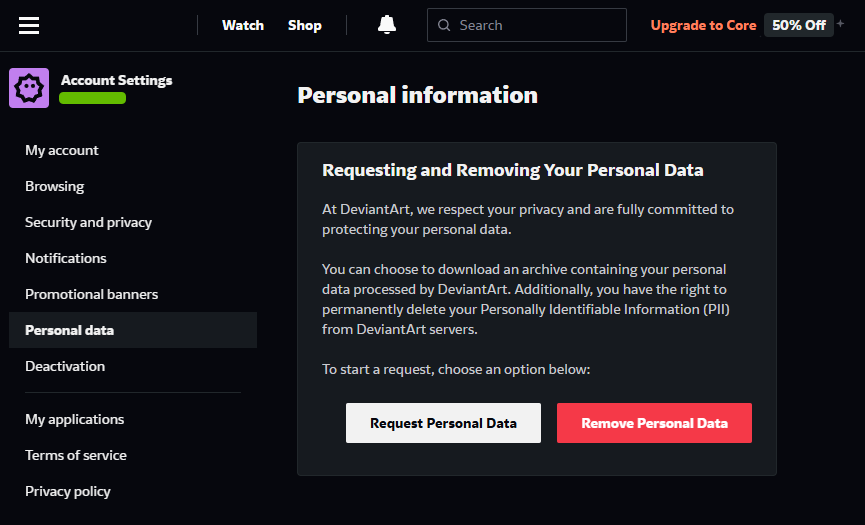
Request Personal Data downloads an archive of what DeviantArt holds. Remove Personal Data permanently deletes your personally identifiable information from its servers.
Be clear about the second one, because it costs more than the page suggests. DeviantArt requires the account to be deactivated before the removal can start, and deactivating hides every deviation and post from public view and schedules them for deletion 21 days later. Once the removal runs, the account goes with it. This is the exit, not a setting you tidy up alongside the other four.
The way back is narrow. Inside the 21-day deactivation grace period, DeviantArt says Customer Support "may be able to help" stop the removal, and you can reactivate only if they do. Outside it, once the removal has begun, you can't. Decide before you click rather than counting on support answering in time.
What none of this covers
Your deviations stay up, public and indexed, unless you take the exit in step 4. The four settings govern your birthday, your browsing trail, who can contact you, and the personal data DeviantArt holds about your account. None touches the art itself, which is the thing a scraper wants. The NoAI label asks for it to be left out of training sets. Taking the work down is the only lever that removes it, and that's a separate job.