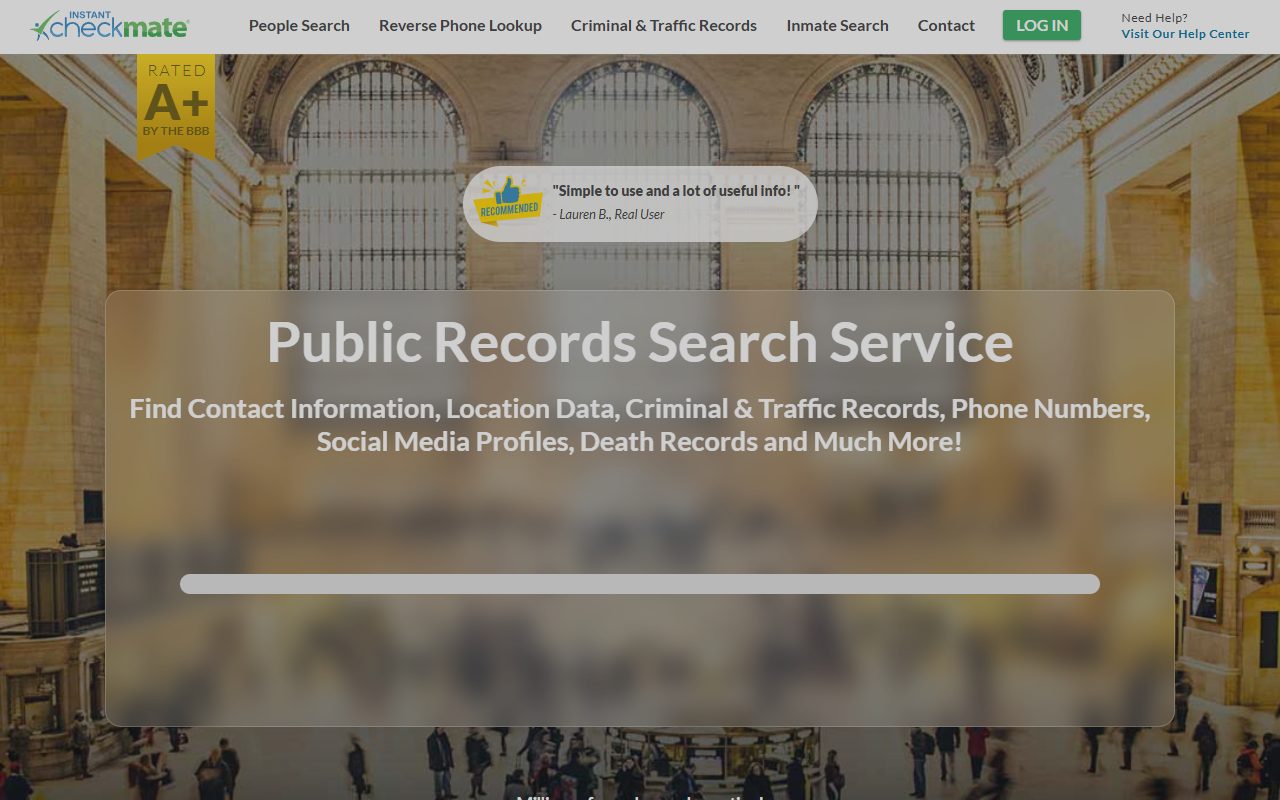
Your Instant Checkmate listing isn't really Instant Checkmate's. The record lives with PeopleConnect, the parent whose one database feeds Instant Checkmate, TruthFinder, Intelius and US Search alike, which is why the brand runs no opt-out of its own. Removal happens on PeopleConnect's Suppression Center, and one request there clears all four sites. Budget about 15 minutes. The flow was walked for real on August 10, 2026, and the screenshots below show the shared form itself. The step that trips people up is the verification: you pick a partially masked email or phone taken from your own record, retype it in full, and only then does a code go out. Verifying isn't the end: the record stays displayed until you set Desired Behavior to Suppressed and save. The PeopleConnect removal guide is the same walkthrough at the source.
About 15 minutes in one sitting - two verification round-trips, no saved progress
Cost
Free
Covers
Instant Checkmate · TruthFinder · Intelius · US Search
Typical turnaround
One-day median per the company's 2024 California filing
Denial rate to expect
1,255 of 24,499 deletion requests denied in 2024
Prereqs
What to have ready
Your full legal name (first, middle and last). The form asks for all three.
Your date of birth, used to pick your record out from other matches.
Access to an old email address or phone number of yours. The verification step lists partially masked contact methods pulled from your own record; you pick one, type it out in full, and it sends a code to that contact. If you can't open any of them, that's where the flow dead-ends.
About 15 minutes in one sitting, since there's an email round-trip and no way to save progress.
The steps
Suppress your listing
01
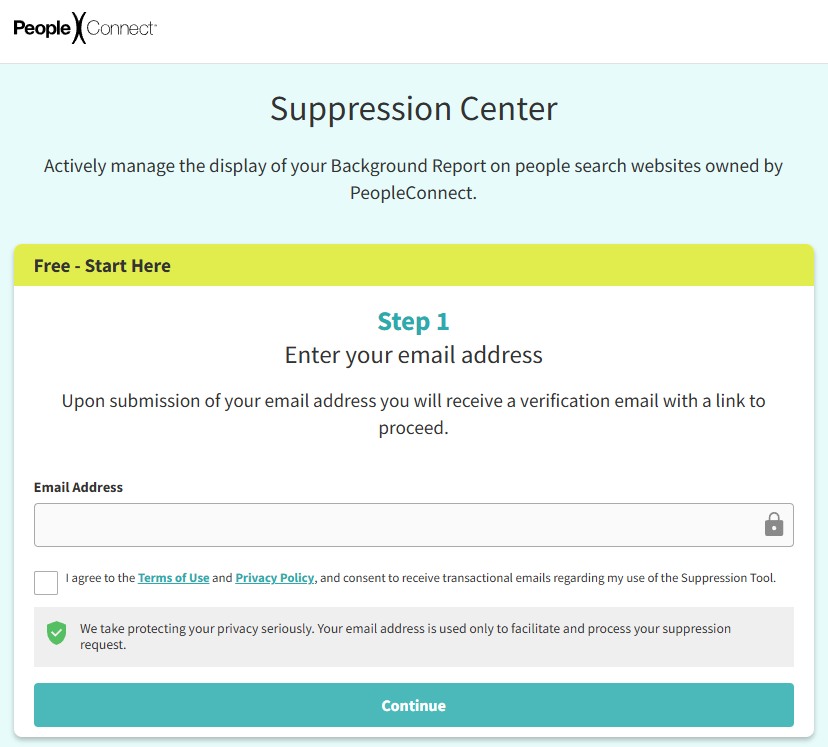
Open the Suppression Center and enter your email
Go to suppression.peopleconnect.us/login - you can also reach it from Exercise My Data Privacy Rights in Instant Checkmate's footer, which lands on instantcheckmate.com/privacy-center first. Notice you're on PeopleConnect's own site now, not Instant Checkmate's - this is where the record actually lives. Submit your email address, agree to the Terms of Use and Privacy Policy, and hit Continue.
The Suppression Center - PeopleConnect's page, covering Instant Checkmate.
02
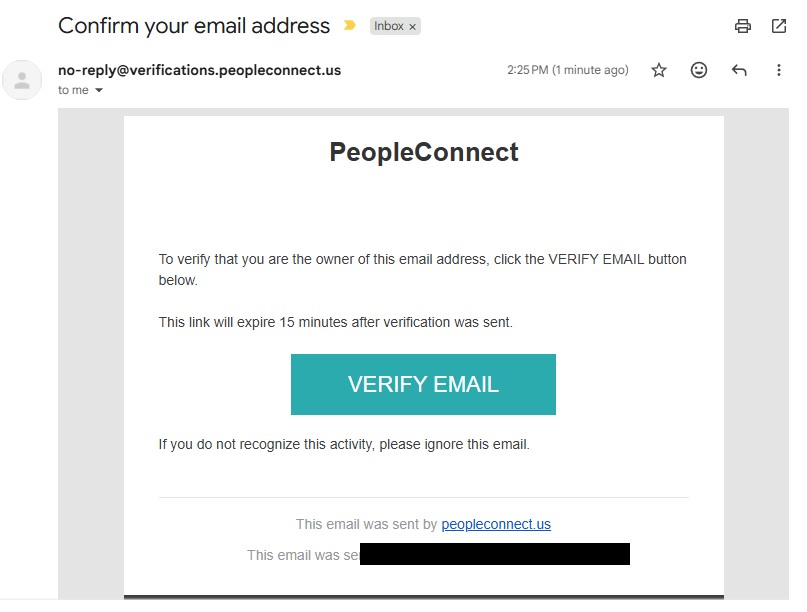
Click the verification email quickly
Open the "Confirm your email address" message from no-reply@verifications.peopleconnect.us and click VERIFY EMAIL. The email's own text says the link expires 15 minutes after it was sent, so click it right away - the link returns you to the portal.
The verification email - the link is only good for 15 minutes.
03
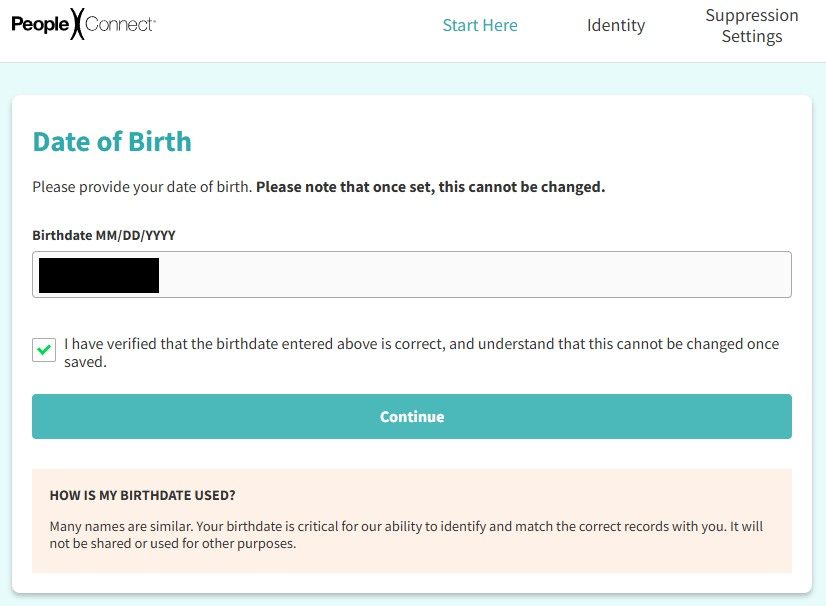
Give your date of birth
The portal asks for your date of birth, which is how it narrows a common name down to one record. The page warns in bold that once set, it can't be changed - double-check it, then tick the verification box and continue.
The Date of Birth screen - check it before you continue.
04
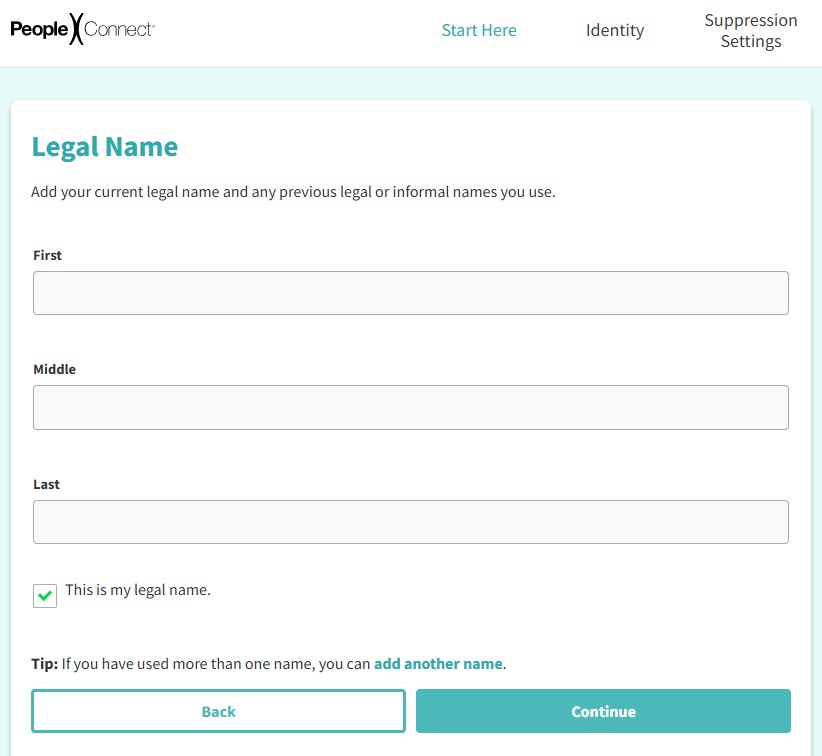
Give your full legal name
Enter your first, middle and last name as they'd appear in public records, not a nickname. Tick the box, use add another name for former names, and continue.
The Legal Name page - add former names here too.
05
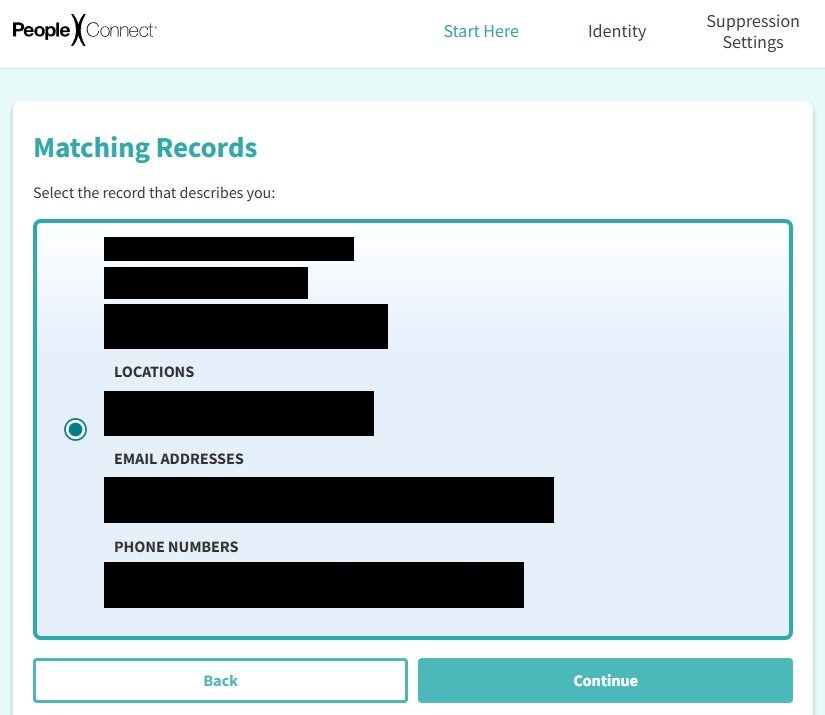
Pick your record
The Matching Records page shows candidates with their aliases, location history, and partially masked contact details. Select yours - if several look plausible, the ages and cities are what tell them apart - and hit Continue.
Matching Records - check the aliases and locations, then select yours.
06
Verify through a contact method on the record
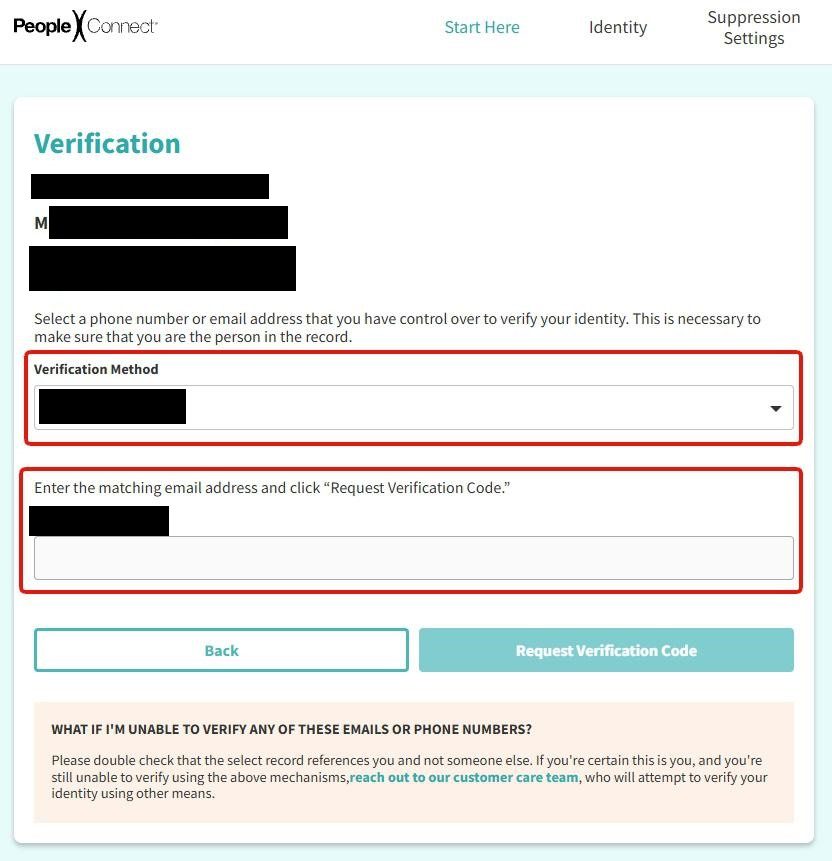
This is the step that stops people, and it has three parts rather than one. Choose a partially masked email or phone from the Verification Method dropdown - it has to be one you can still open, not just one you recognise. Then type that contact out in full in the field below and click Request Verification Code; nothing is sent until you do, and a code field only appears on the page afterwards.
Choosing the masked contact is only the first of three actions on this screen.
If you don't have access to any of the contact methods in the dropdown, the tool dead-ends. Reach out manually at privacy@peopleconnect.us instead.
07
Type the code in and submit it
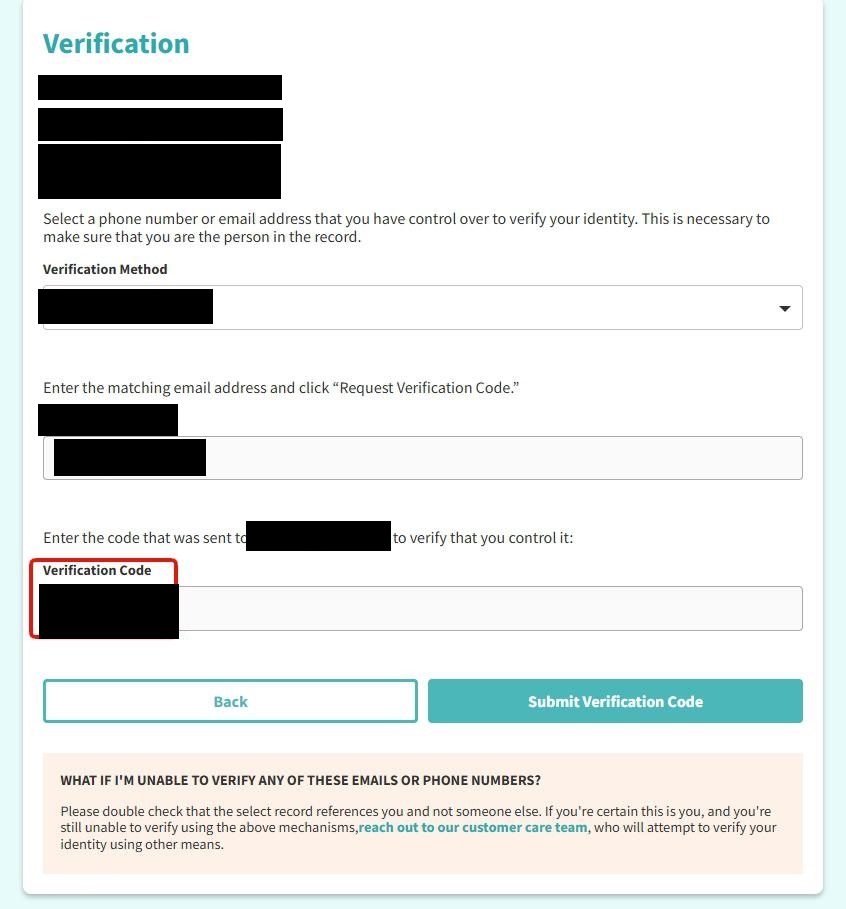
A Verification Code box appears beneath the contact you just verified. Enter the code and click Submit Verification Code. The button is the only thing that submits it; typing the code and waiting leaves you on the same screen.
The code box and its Submit Verification Code button, at the foot of the same page.
08
Click Continue, then set Desired Behavior to Suppressed and save
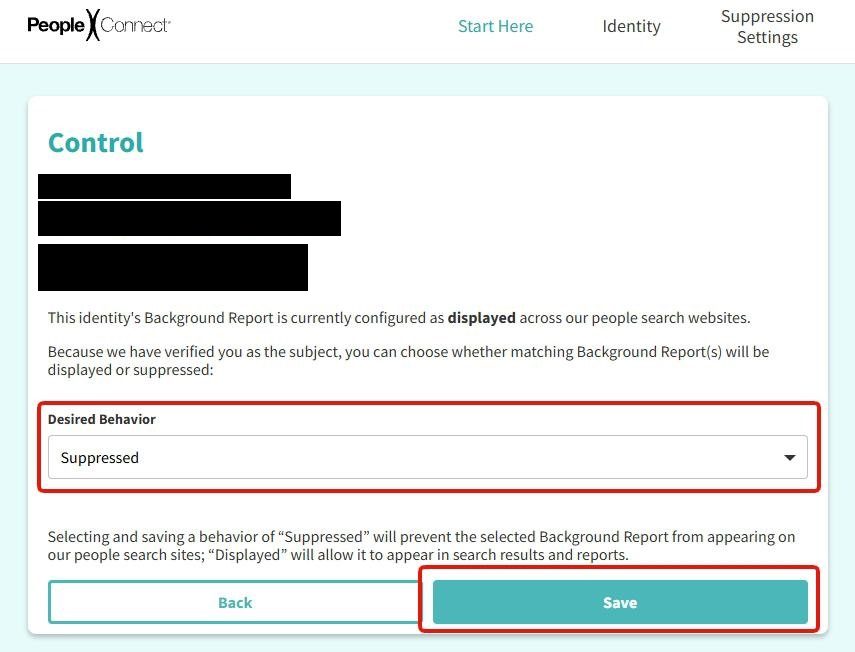
Verifying isn't suppressing. The confirmation screen says as much - "Select 'Continue' to manage suppression rules for this record" - and clicking through lands on a Control page that still reads displayed. Open Desired Behavior, pick Suppressed, and hit Save. One saved setting covers Instant Checkmate, TruthFinder, Intelius and US Search.
The record stays displayed until you choose Suppressed and save.
Stopping at the green "Verified" banner leaves you listed. Verifying and suppressing are two different screens, and only the second one changes what the sites show.
Confirm
Confirm it worked
The company's own California filing reports a one-day median response for deletion requests in 2024, so this shouldn't drag. After 72 hours, search your name on Instant Checkmate and on TruthFinder, Intelius and US Search. One request is supposed to cover all four, and checking is how you find out whether it did. Search ZabaSearch and Addresses.com too, because PeopleConnect's broader wording covers name listings on those Intelius people-search sites without naming either one.
If your record is still there after a week, that's worth taking seriously rather than waiting longer. The same filing reports 1,255 denials out of 24,499 deletion requests, so a request that failed has probably already failed.
Scope
What suppression does and doesn't cover
Name searches only. PeopleConnect's own text limits suppression to name-based search results. A report pulled by phone number, address, or email isn't covered by that wording.
Classmates is excluded. PeopleConnect specifically names TruthFinder.com, InstantCheckmate.com, Intelius.com, and USSearch.com as examples. It excludes Classmates by name, so Classmates needs a separate request.
ZabaSearch and Addresses.com are covered but not named. PeopleConnect's wording covers name listings on its people-search sites, and ZabaSearch and Addresses.com are Intelius people-search sites. Neither appears among the four named examples, so check both after suppression.
The three sister domains aren't named.CellPhoneDirectory.com, FreePeople-Search.com, and CheatersLie.com send searches to Instant Checkmate. Suppressing the Instant Checkmate record should clear their results, so check each domain afterward.
Public records stay public. Suppression hides the broker's listing. It doesn't touch the county and state records the listing was built from.
If it fails
Troubleshooting
None of the masked contact methods are ones you can still open. Recognising them isn't enough. The code has to reach you. If every listed method is dead, email privacy@peopleconnect.us and ask for the suppression manually.
No confirmation email. Check spam, then retry with a different address. The flow doesn't proceed without the click.
Request denied. Escalate to the registrant, not to PeopleConnect. Instant Checkmate LLC is the entity on California's registry, so a Delete Act complaint names Instant Checkmate LLC.
This is a billing problem, not a privacy one. Cancel through your account or Customer Care on weekdays, 7:00am to 4:00pm PT, and dispute post-cancellation charges with your card issuer. Look for a chkmate* descriptor on the statement.
Stay off
Keep your record off
Suppression hides a record; it doesn't stop the pipeline that built it. New court filings, property transactions, and address changes all feed back in, so a listing can return months later looking freshly minted. Recheck quarterly, and after any move. Redact's data-broker scan watches the PeopleConnect brands and refiles when your details resurface.
Take yourself off data broker sites
Redact scans data broker sites from your device, finds where your details are listed, and submits the removal requests for you. If a broker relists you, it files again.
August 10, 2026 · Flow confirmed by a real walkthrough of the shared Suppression Center - the same form serves all four PeopleConnect sites, and the step screenshots live on the PeopleConnect removal guide. The verification gate takes three actions, not one: pick a masked contact from your record, type it out in full, then click Request Verification Code, which is what sends the code. The email link earlier in the flow expires after 15 minutes. The August walk stopped at record selection; the verification screens and the two after them are documented from the Intelius walk of May 21, 2026, which captured all four. This corrects an earlier revision that described the code as completing the removal - it verifies identity, and the record stays displayed until 'Desired Behavior → Suppressed' is saved.