PeopleFinders' opt-out is a 4-step email-verified flow that starts at peoplefinders.com/opt-out. PeopleFinders only honors opt-out requests from residents of states with comprehensive consumer privacy laws. If your state isn't on the list (currently about 19 states - California, Virginia, Colorado, etc.), the company sends a rejection email saying it "cannot process the request at this time." This is a meaningful structural barrier - 31 states plus DC currently don't qualify. The flow itself is straightforward; state eligibility is the gating step.
Before you remove your data: See the PeopleFinders data broker profile for the Rob Miller founding history, the Confi-Chek network, the $4.89M Eisenberg v. Confi-Chek IRPA settlement, and the BBB C rating with documented unauthorized-recurring-billing complaint pattern.
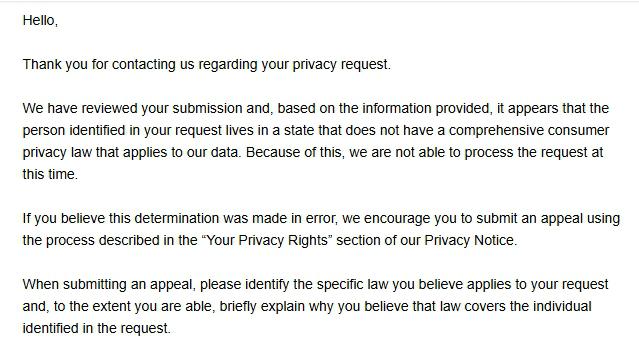
PeopleFinders gates opt-outs on state residency. The rejection email states: "based on the information provided, it appears that the person identified in your request lives in a state that does not have a comprehensive consumer privacy law that applies to our data. Because of this, we are not able to process the request at this time." Roughly 19 states currently have comprehensive consumer privacy laws PeopleFinders will honor; residents of the other 31 states + DC are turned away. If your state passes a comprehensive privacy law later, the door opens.
If you arrived from PrivateEye or PublicRecordsNow, this is the right guide. Both sites hand every search to PeopleFinders and have no removal form of their own, so this opt-out, state-eligibility gate included, is the only route for a record found through them.
Eligible states
Which states PeopleFinders will honor an opt-out from
~19 states · expanding
PeopleFinders' rejection email cites "a state that does not have a comprehensive consumer privacy law that applies to our data" as the basis for refusal. The states whose comprehensive consumer privacy laws are in effect as of May 2026 - and whose residents PeopleFinders should honor opt-outs from - are listed below. State coverage is expanding each legislative session; the IAPP US State Privacy Legislation Tracker is the canonical source for the latest list.
California
CCPA / CPRA
Colorado
CPA
Connecticut
CTDPA
Delaware
DPDPA
Indiana
ICDPA
Iowa
ICDPA
Kentucky
KCDPA
Maryland
MODPA
Minnesota
MCDPA
Montana
MCDPA
Nebraska
NDPA
New Hampshire
NHPA
New Jersey
NJDPCA
Oregon
OCPA
Rhode Island
DTPPA
Tennessee
TIPA
Texas
TDPSA
Utah
UCPA
Virginia
VCDPA
Effective dates vary by state. Several of the 2025-2026 laws have business-size thresholds and rolling effective dates. Some still have grace periods before enforcement begins. If your state passed a comprehensive privacy law that isn't yet in effect, PeopleFinders may still reject requests until the effective date arrives - cite the specific statute and effective date in your appeal if you believe yours qualifies.
If your state isn't on the list, plan accordingly. Roughly 31 states plus DC didn't have a comprehensive consumer privacy law in force when this was written, and residents of those states have no statutory right to compel the opt-out - the company will refuse and there's no enforcement backstop. Check the current position before you assume that applies to you: these laws keep taking effect on rolling dates, Nebraska's arrived on January 1, 2025, and a list like this one goes stale between them. Submit the opt-out promptly once your state's law is in force. Some state laws also create private rights of action for documented violations, which is how you escalate if PeopleFinders refuses an opt-out from an eligible state.
The 4-step flow
Submit the PeopleFinders opt-out
~10 minutes
The flow has four distinct stages, starting with (1) the initial "Right to Opt-out" page with a green Next button, (2) the email verification link, (3) the Record Suppression Form with full personal details, and (4) the determination email - either acceptance with a 3-day removal SLA, or rejection on state-eligibility grounds.
01
Open peoplefinders.com/opt-out and click the green Next button
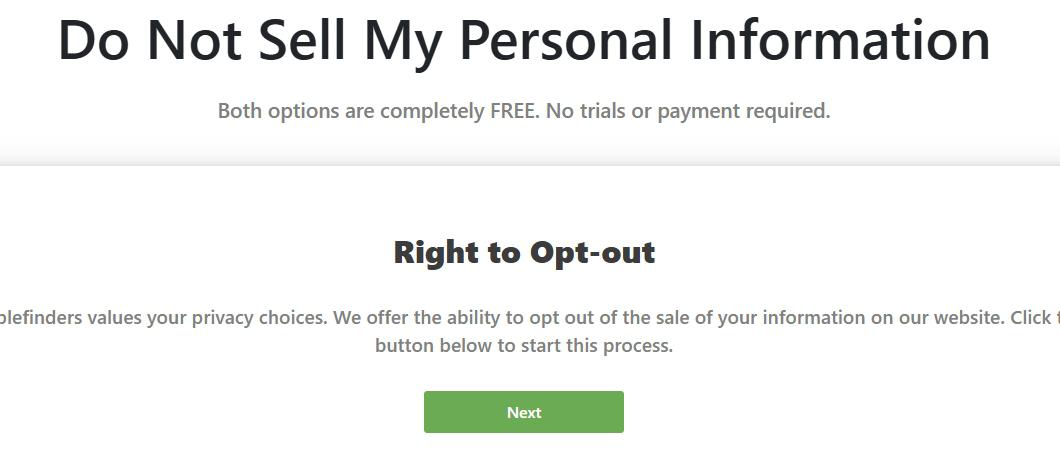
Go to peoplefinders.com/opt-out. The landing page is titled "Do Not Sell My Personal Information" with the subhead "Both options are completely FREE. No trials or payment required."
Scroll to the "Right to Opt-out" section. The page explains: "peoplefinders values your privacy choices. We offer the ability to opt out of the sale of your information on our website. Click the button below to start this process."
Click the green Next button. You'll land on a short form that asks for the minimum identification fields needed to send the verification email. Fill in the fields and submit.
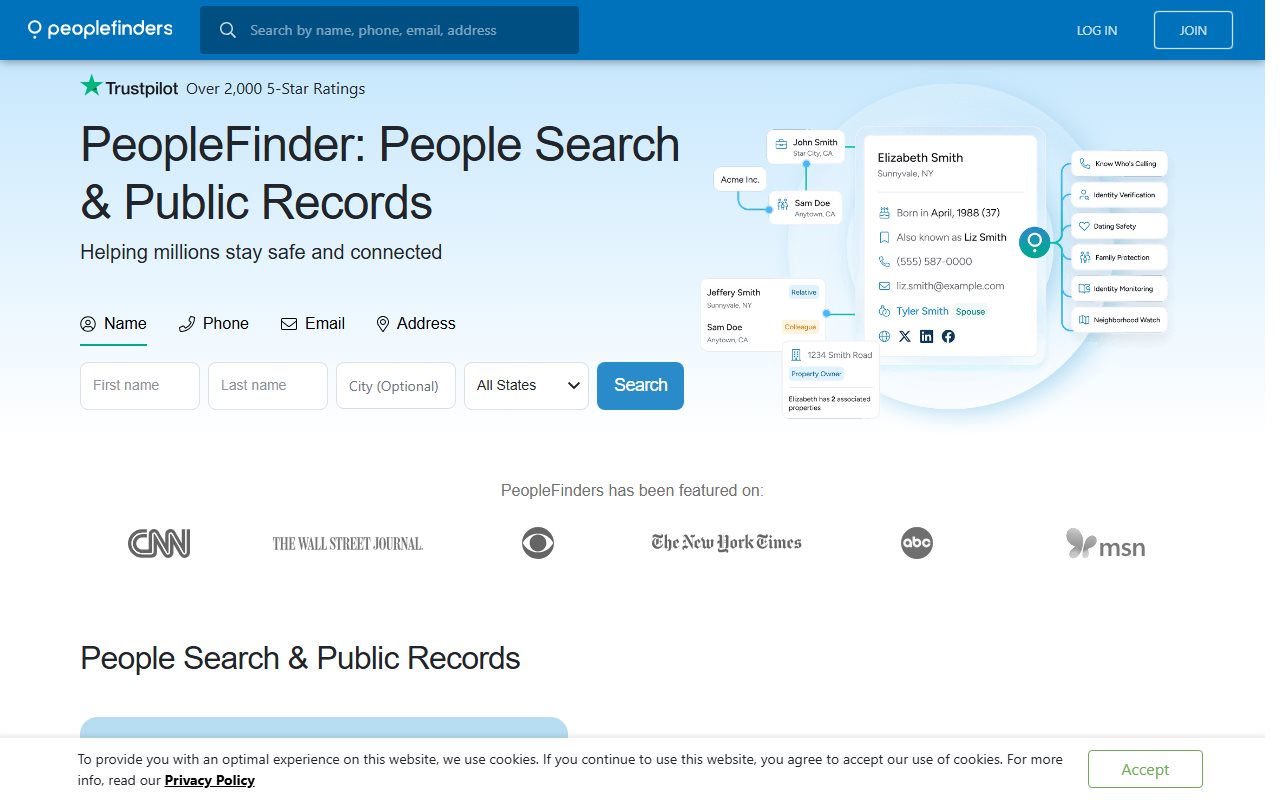
peoplefinders.com/opt-out - click the green Next button to start the flow.
02
Open the verification email and click the "Click here to fill out the form" button
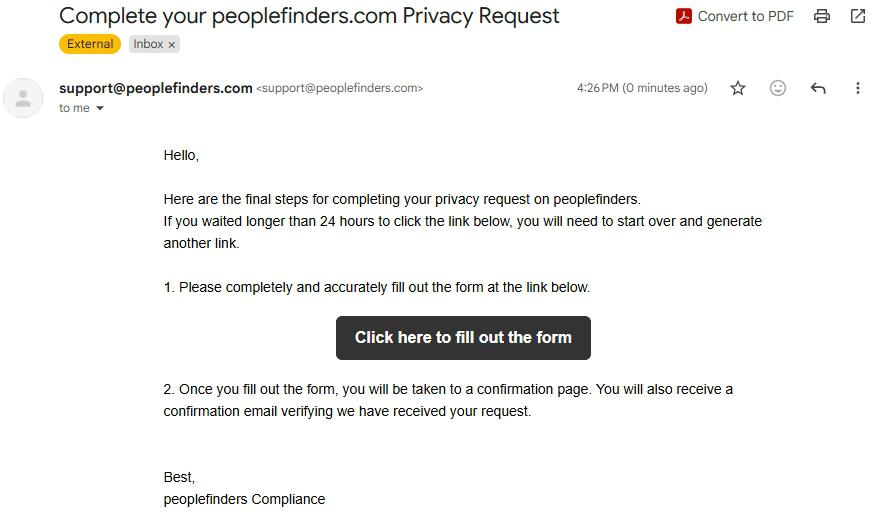
Check the inbox of the email address you submitted. The verification email arrives from support@peoplefinders.com with the subject "Complete your peoplefinders.com Privacy Request".
The email explicitly says: "If you waited longer than 24 hours to click the link below, you will need to start over and generate another link." The 24- hour window is hard - if you miss it, restart from step 1.
Click the dark "Click here to fill out the form" button. It opens the Record Suppression Form on peoplefinders.com.
Verification email with the 24-hour link expiration warning and the form button.
03
Fill out the Record Suppression Form
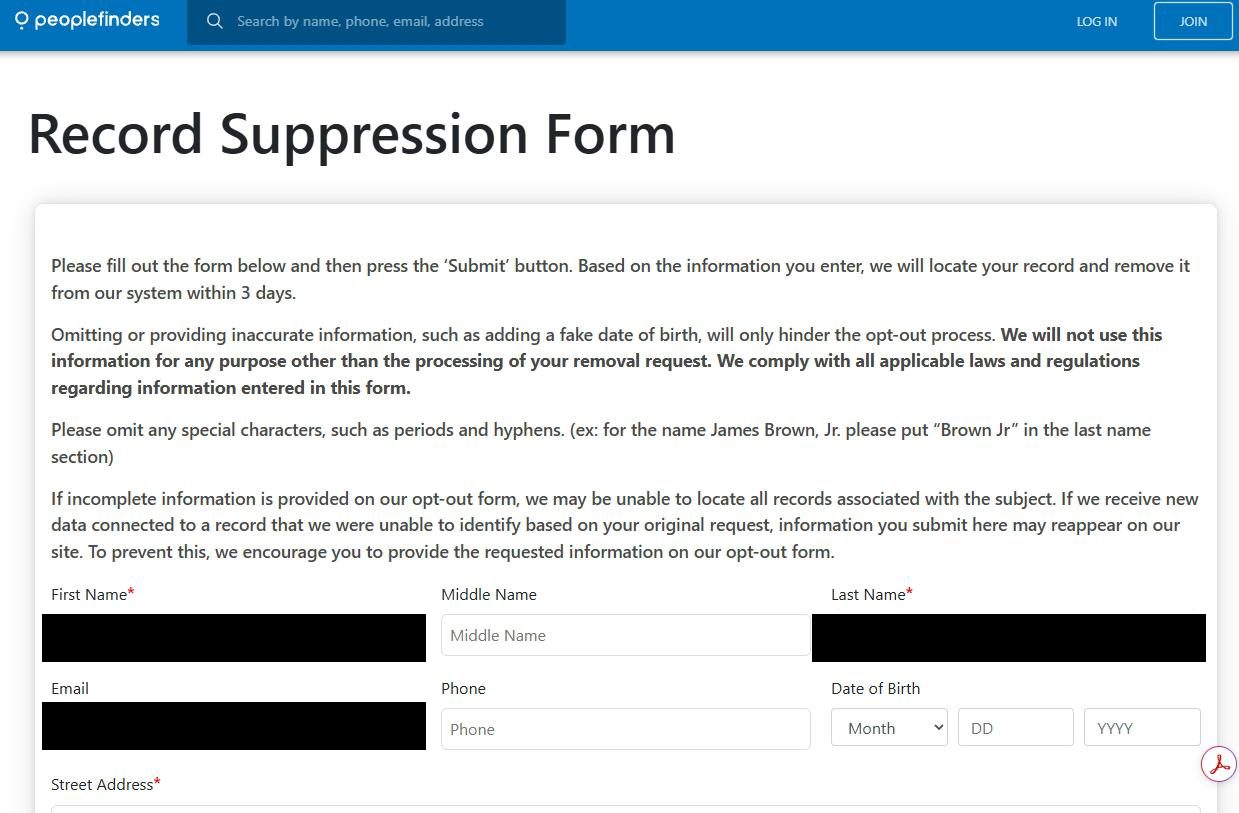
The form is titled Record Suppression Form. The instructions say: "Based on the information you enter, we will locate your record and remove it from our system within 3 days... Omitting or providing inaccurate information, such as adding a fake date of birth, will only hinder the opt-out process."
Fill in the required fields (asterisked):
First Name (required)
Middle Name (optional)
Last Name (required)
Email (the one you submitted in step 1)
Phone (optional but improves match)
Date of Birth (optional but improves match)
Street Address (required) - and likely city, state, ZIP further down the form
The form instructions specifically note: "Please omit any special characters, such as periods and hyphens. (ex: for the name James Brown, Jr. please put 'Brown Jr' in the last name section)." Follow that convention.
Providing more fields = better match confidence = lower risk that the record is missed during suppression. PeopleFinders' wording: "If incomplete information is provided on our opt-out form, we may be unable to locate all records associated with the subject."
Submit the form. The acceptance path takes you to a confirmation page and PeopleFinders sends a confirmation email. The rejection path is documented in the next section.
The Record Suppression Form - fill required fields completely and accurately.
04
Wait for the determination email
PeopleFinders sends a follow-up email with the determination. There are two outcomes:
Acceptance: the request is being processed, removal claimed within 3 days. Re-search your name at peoplefinders.com on day 3 to confirm.
Rejection on state-eligibility grounds: PeopleFinders states that your state doesn't have a comprehensive consumer privacy law that applies to their data. See the next section for the appeal path.
If you receive the rejection email, your primary options are (a) appeal citing a specific applicable state law, or (b) wait until your state passes a comprehensive privacy law and resubmit.
If you're rejected
What to do if PeopleFinders refuses on state-eligibility grounds
Appeal path + alternatives
PeopleFinders' rejection email gives you a specific appeal path. Cite the applicable state law and explain why it covers you. The full rejection text and the appeal instructions are below.
The rejection email - state-eligibility refusal with an appeal invitation.
Full text of the rejection email:
"Thank you for contacting us regarding your privacy request." "We have reviewed your submission and, based on the information provided, it appears that the person identified in your request lives in a state that does not have a comprehensive consumer privacy law that applies to our data. Because of this, we are not able to process the request at this time." "If you believe this determination was made in error, we encourage you to submit an appeal using the process described in the 'Your Privacy Rights' section of our Privacy Notice." "When submitting an appeal, please identify the specific law you believe applies to your request and, to the extent you are able, briefly explain why you believe that law covers the individual identified in the request."
Practical appeal options:
You live in an eligible state but used a non-resident proxy. If you submitted with an address or phone tied to an ineligible state, PeopleFinders' geolocation matched the wrong jurisdiction. Resubmit with your eligible-state address and phone.
Cite the specific state statute and section. The appeal invitation explicitly asks for "the specific law you believe applies." Name the statute (e.g., "California Consumer Privacy Act, Cal. Civ. Code § 1798.105" for California deletion rights) and briefly state that you are a resident of the enacting state.
If your state has a data-broker registry specifically (California Delete Act, Vermont data broker law, Texas data broker registration, Oregon data broker registration), cite that registry-specific law in addition to any comprehensive privacy law. Multiple independent legal bases strengthen the appeal.
File a state Attorney General complaint if PeopleFinders refuses a clearly eligible request. Most state privacy laws are enforced by the state AG (and in California, the CPPA). Documented refusal of a valid request is the kind of enforcement hook these agencies are looking for, particularly the CPPA Data Broker Strike Force launched in November 2025.
If you're in an ineligible state, the opt-out path is closed at PeopleFinders. Track your state's legislative session for any comprehensive privacy bill and resubmit PeopleFinders promptly when one takes effect.
Verify
Confirming the opt-out worked
3-day SLA
Day 1-3. If you received an acceptance email rather than the state-eligibility rejection, removal should complete within 3 days of form submission. Re-search your name on peoplefinders.com in an incognito window at the 72-hour mark to confirm the listing has dropped.
Day 7. Final check. If the record is still visible at one week and you received an acceptance email, the submission may have silently failed. Restart from step 1.
Save the determination email. Whether acceptance or rejection, archive the email PeopleFinders sends. The acceptance email is your proof of submission; the rejection email is your reference for the appeal process or for future re-submission after a state law passes.
Stay off
Keep your data off PeopleFinders (and the broader Confi-Chek network)
Source-side prevention
Re-run the opt-out annually (if eligible). The Confi-Chek backend refreshes continuously from public-records sources. A successful opt-out today doesn't prevent a future refresh from re-indexing you. Annual re-submission is the standard maintenance cycle for residents of eligible states.
Track your state's privacy legislation if you're ineligible today. Roughly 31 states + DC don't yet have a comprehensive consumer privacy law. The IAPP US State Privacy Legislation Tracker is the canonical source for pending bills and effective dates. Move immediately after enactment - submit the opt-out in the first week the law takes effect.
PeopleFinders is one of many people- search brokers. Opting out across the Confi-Chek network doesn't propagate to independent operators like Spokeo, BeenVerified, Whitepages, MyLife, or Intelius. Each has its own opt-out flow.
Address the public-records source. PeopleFinders pulls from county and state court filings, property records, voter registration files, marriage and divorce records, and third-party data brokers. Where state law allows, opt out of voter-roll commercial sharing and request public-records redactions for safety reasons. P.O. boxes for property and license filings limit the address-exposure surface - useful regardless of your state's privacy law.
If you move into an eligible state, submit the opt-out promptly. A new address in a state with a comprehensive privacy law gives you a new path. PeopleFinders' state-eligibility check appears to run against the address you submit on the form - moving into an eligible state and resubmitting is the documented path forward.
Use a virtual card for any people-search-broker purchase. If you ever need to buy a PeopleFinders report (or any similar brand's report), use a virtual card or single-use card. The documented unauthorized- recurring-billing complaint pattern on the BBB profile is consistent enough that disposable payment methods are the standard mitigation.
Take yourself off data broker sites
Redact scans data broker sites from your device, finds where your details are listed, and submits the removal requests for you. If a broker relists you, it files again.
September 24, 2026 · PrivateEye and PublicRecordsNow rechecked. Both are now referral fronts with no removal form, so the fallbacks through them are gone. Originally written May 28, 2026.