Broker profile
FamilySearch
A free, non-profit genealogy service operated by FamilySearch International, a subsidiary of The Church of Jesus Christ of Latter-day Saints. It holds the largest genealogical record collection in the world: billions of indexed historical records plus a user-contributed shared Family Tree. Founded as the Genealogical Society of Utah in 1894 and led by Stephen T. Rockwood since 2015. It doesn't sell consumer data, but the Church's 1995 agreement to stop posthumous proxy baptism of Holocaust victims reflects long-running controversy.
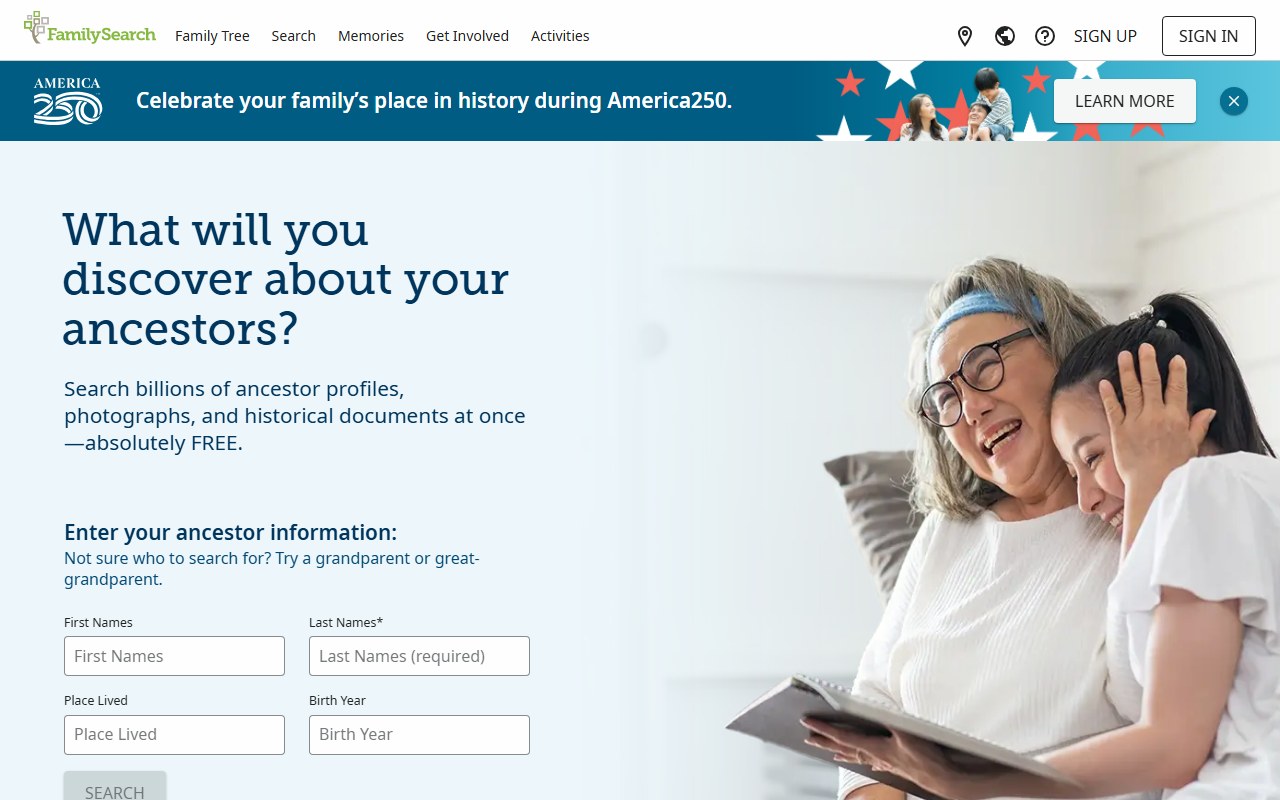
FamilySearch overview
At a glance


- Data published
- Moderate
- Re-listing frequency
- Occasional
- Complaint record
- Mixed
- Opt-out friction
- Moderate
- Operator opacity
- Fully disclosed
- Prior data incidents
- None documented
Each broker is scored 1 to 4 across the six dimensions above; higher means more exposure, and the overall gauge is their average.
What each dimension means
- Data published: how much and how sensitive the personal data they put out.
- Re-listing frequency: how quickly you reappear after opting out.
- Complaint record: the volume and pattern of complaints across BBB, Trustpilot, and Sitejabber. No listing, or a listing with no reviews, counts against the broker.
- Opt-out friction: how hard the removal process is to complete.
- Operator opacity: how hidden the operating company and its principals are.
- Prior data incidents: history of breaches or leaks of the data they hold.
- Category
Genealogy · historical records
- Operating entity
FamilySearch International
- Founded
Nov 13, 1894
- CEO
Stephen T. Rockwood
- Headquarters
Salt Lake City, UT
- Parent
The Church of Jesus Christ of Latter-day Saints
- Structure
Non-profit · free · volunteer-driven
- Notable controversy
Proxy baptism of deceased
- FCRA covered?
No
Background
Background


FamilySearch's product is free public access to the largest genealogical record collection in the world. The data includes billions of indexed historical records (census, vital records, immigration, military, parish, probate), the user-contributed shared Family Tree, and a Memories archive of photos, documents, and stories. Access is free for everyone; the underlying religious motivation is that the LDS Church holds the genealogical data so members can perform proxy temple ordinances (posthumous baptisms and other rites) for deceased ancestors. Users don't need to be LDS members.
- Founded
November 13, 1894
- Renamed
FamilySearch International
- Cost
Free
- Records
Billions of indexed historical records globally
- Physical access
Family History Library + ~5,000 centers
- Partners
Ancestry · MyHeritage · FindMyPast · Geneanet
The Genealogical Society of Utah was founded on November 13, 1894 by Wilford Woodruff, the fourth President of the LDS Church, to support the Church's doctrinal practice of proxy temple ordinances for deceased ancestors. The Society grew into the world's largest collector of genealogical microfilm (the Granite Mountain Records Vault in Little Cottonwood Canyon outside Salt Lake City has stored microfilm and digital copies of vital records from ~100 countries since 1965). The consumer-facing website launched as FamilySearch.org in 1999 and the modern shared Family Tree platform launched in the early 2010s.
Today FamilySearch operates as FamilySearch International, the Church's Family History Department. The organization runs the Family History Library in Salt Lake City (the world's largest genealogical library), about 5,000 Family History Centers worldwide (most located in LDS meetinghouses, open to the public), the RootsTech annual conference, and partnerships with for-profit genealogy sites that exchange data and search interoperability. Stephen T. Rockwood became President and CEO on October 1, 2015, replacing Dennis Brimhall.
FamilySearch is a different kind of "data broker" than the people-search brokers in this directory. It's structurally a non-profit religious ministry, not a for-profit data company. It doesn't sell consumer data, doesn't run targeted advertising, and doesn't monetize the records. The consumer-privacy concerns are nonetheless real:
- Voluntary family-tree contributions can expose information about your living relatives that you (the person being added) didn't consent to share
- Partnerships with for-profit sites (Ancestry, MyHeritage, FindMyPast, Geneanet) extend the reach of FamilySearch's data into commercial channels
- The Church's use of the data for proxy temple ordinances is the underlying purpose, and that practice has drawn ongoing objections from Jewish, Catholic, and other religious communities
- The opt-out path is centralized through the Church's Data Privacy Office rather than self-service on the website
Closest analog in this directory: Ancestry - the for-profit consumer genealogy service that runs DNA testing alongside family-tree records. FamilySearch is functionally the non-profit, free counterpart; FamilySearch and Ancestry have a long-running data partnership and overlap heavily in record coverage. FamilyTreeNow is also in the directory but operates as a free public-records people-search site under a "genealogy" framing rather than a true genealogy service.
Proxy baptism of Holocaust victims - the recurring controversy. The LDS practice of posthumous proxy baptism for deceased individuals has drawn objections from Jewish, Catholic, and other religious leaders since the 1990s. A 1995 agreement between the Church and Jewish leaders required that the Church stop posthumously baptizing Holocaust victims; the Church has stated it has removed more than 300,000 Holocaust victim names from its temple records under that agreement. Researcher Helen Radkey and others have documented continued violations, including the proxy baptism of Anne Frank (multiple times) and other Holocaust victims. The Church developed the "New FamilySearch" platform in 2012 with stronger name-submission controls and assigns four full-time employees to monitor for protected names; Rabbi Gary Greenebaum was retained to receive monthly accountability reports. Whether this constitutes a privacy concern depends on your religious framing, but it's the dominant non-legal reputational issue for the organization.
Data Published
Data types


Indexed historical records: census, birth, marriage, death, immigration, naturalization, military, draft, probate, land, parish, and church records (billions of entries globally)
Shared Family Tree: user-contributed family-relationship data on deceased individuals (visible to all users) and living individuals (private to the entering user)
Memories: photos, documents, audio recordings, and stories uploaded by users about ancestors or themselves
Account data for registered users: name, email, location, account-activity history
Granite Mountain Records Vault: digitized microfilm archive (~100 countries' vital records since 1965)
RootsTech conference content: speaker sessions, attendee registration data
Search and usage analytics tied to logged-in accounts
Data exchanged with partner sites: Ancestry, MyHeritage, FindMyPast, Geneanet, American Ancestors, Filae
How the data is sourced: A mix of (a) government records (census, vital records, court records) digitized under license with the source jurisdictions, (b) religious institution archives (parish records, synagogue records, etc.) contributed by partner organizations, (c) volunteer-indexed records (FamilySearch uses thousands of volunteer indexers worldwide to transcribe scanned images), (d) user-contributed Family Tree data uploaded by registered users, and (e) data received through partnerships with for-profit genealogy sites in exchange for reciprocal data sharing. Users don't pay for the service; the LDS Church funds the underlying infrastructure.
Living vs deceased people - the privacy split. FamilySearch treats living and deceased people differently. Deceased individuals in the shared Family Tree are visible to all users and editable by anyone with an account - this is the design choice that enables collaborative genealogy but also drives common complaints about strangers altering tree entries. Living individuals are visible only to the user who entered them; they are kept in a "private space" and can't be searched or seen by other users. The line between living and deceased is set by date of birth and recorded death; ambiguous cases default to "living" / private.
Data exchanged with for-profit partners. Through partnerships with Ancestry, MyHeritage, FindMyPast, Geneanet, and others, FamilySearch shares some record collections with paid subscribers of those sites. Conversely, FamilySearch members can search the partner sites' records through FamilySearch. So user-contributed Family Tree data on deceased individuals - which is public on FamilySearch - is reachable inside paid commercial databases without the user choosing to publish it on those platforms.
Contact
Contacts & links


- Operating entity
FamilySearch International (LDS Church non-profit)
- Headquarters
50 E. North Temple Street Salt Lake City, UT 84150
- LDS Data Privacy Office (FCRA, CCPA, DSR requests)
- Data Privacy Office mailing address
Data Privacy Office 50 E. North Temple Street Salt Lake City, UT 84150-0005
- Privacy settings in Family Tree
- Remove living person from historical records
- Global Privacy Notice
- Family History Library (Salt Lake City)
35 N. West Temple Street, Salt Lake City, UT 84150 World's largest genealogical library; public access free
- General website
Network
Data partners


FamilySearch sits inside the LDS Church's corporate structure but also runs an extensive data-exchange relationship with the major for-profit genealogy sites. That means user-contributed and indexed records flow between FamilySearch and the commercial sites in both directions.
Cross-category comparison: within this directory, the closest commercial analog is Ancestry - the for-profit consumer genealogy service that also runs DNA testing. FamilySearch and Ancestry partner extensively and share records bidirectionally. The other genealogy-adjacent broker in this directory is FamilyTreeNow, which markets a "genealogy" framing but is functionally a free public-records people-search site - different shape from FamilySearch's true non-profit genealogy mission. Across categories, FamilySearch has no direct analog among the people-search brokers (Whitepages, BeenVerified, etc.) - those operate consumer-search businesses on public-records data; FamilySearch is collaboratively curated genealogical data.
Data exchange runs both ways with commercial partners
A privacy or deletion request submitted to FamilySearch covers FamilySearch's holdings only. It doesn't automatically propagate to Ancestry, MyHeritage, FindMyPast, Geneanet, or other partner sites that may have separately ingested records sourced through these partnerships. If your data appears on a partner site you'll need to submit a separate request there. Likewise, opting out at Ancestry doesn't remove your data from FamilySearch.
Reputation
Trust signals


FamilySearch's reputation splits in two. Long-time genealogists praise the free access to record collections and the Memories archive; newer users frequently complain about the open-edit shared Family Tree where anyone can alter ancestor data without evidence. The BBB rating reflects a non-response pattern on a small number of complaints rather than systemic complaint volume.
Open-edit Family Tree: any registered user can alter ancestor records on deceased relatives, often without source documentation
Ancestors with verifiable evidence being deleted or merged incorrectly by other users
Slow / unhelpful customer service responses on tree-correction requests
Privacy requests routed through the Church's Data Privacy Office taking longer than expected
Concerns about proxy temple ordinances being performed on deceased relatives without family knowledge or consent
Confusion about how FamilySearch data flows into partner sites (Ancestry, MyHeritage, etc.) for paid-subscriber search
Common complaint themes:
Litigation
Litigation history


No confirmed FTC enforcement action, state Attorney General consent decree, CCPA / CPRA enforcement, or named consumer class action against FamilySearch International or its parent LDS Church Family History Department as of the last-updated date. The dominant accountability mechanism is the 1995 agreement with Jewish leaders regarding proxy baptism of Holocaust victims - a religious-and-cultural framework rather than a legal one. Civil litigation against FamilySearch is rare because the service is free, the legal entity is a church-affiliated non-profit (which carries certain First Amendment and religious-organization protections), and the data practices on living people are conservative by design.
Related and contextual matters:
- 1995 Church-Jewish Leaders Agreement - the Church agreed to stop posthumously baptizing Holocaust victims and remove their names from temple records. The Church has stated it has removed more than 300,000 names. Researcher Helen Radkey has documented continued violations including the proxy baptism of Anne Frank (multiple times); the Church has tightened submission controls in response but acknowledges the agreement isn't perfectly enforced.
- 2012 "New FamilySearch" platform - the Church developed enhanced regulation of name submissions and stated that "without exception, Church members must not submit for proxy temple ordinances any names from unauthorized groups, such as celebrities and Jewish Holocaust victims." Four full-time employees are assigned to monitor.
- Periodic Catholic and other religious objections - similar issues have been raised by Catholic, Hindu, and other faith communities regarding posthumous baptism of their members; the Church has issued similar non-baptism guidance for unaffiliated celebrities and historical figures.
- No state Delete Act enforcement against FamilySearch under California's data-broker framework. Whether FamilySearch meets the CA data-broker definition is unsettled - the "direct relationship" exemption (CCPA / CPRA) arguably covers registered users for their own data, while non-user data (relatives added to trees) sits in a gray zone.
FAQ
Q & A


Is FamilySearch a data broker?
Yes, in the sense that FamilySearch aggregates and republishes the largest genealogical record collection in the world - but it differs structurally from the for-profit people-search brokers in this directory. FamilySearch is a free, non-profit service operated by FamilySearch International, a subsidiary of The Church of Jesus Christ of Latter-day Saints (the LDS Church). It doesn't sell consumer data. The privacy concerns are different. Voluntary family-tree contributions can expose information about your living relatives, partnerships with for-profit sites (Ancestry, MyHeritage, FindMyPast, Geneanet) extend the reach of that data, and the Church's religious use of the genealogical data (specifically proxy-baptism temple ordinances) has generated ongoing controversy.
Who operates FamilySearch?
FamilySearch is operated by FamilySearch International, a non-profit subsidiary of The Church of Jesus Christ of Latter-day Saints (the LDS Church). It's part of the Church's Family History Department, headquartered at 50 E. North Temple Street, Salt Lake City, Utah 84150. Stephen T. Rockwood has been President and CEO since October 1, 2015. The organization was founded November 13, 1894 as the Genealogical Society of Utah by Wilford Woodruff, the fourth President of the LDS Church; it celebrated its 130-year anniversary in November 2024.
What information does FamilySearch collect?
FamilySearch holds billions of indexed historical records (census, vital records, immigration, military, church records), the user-contributed shared Family Tree, the Memories collection (photos, documents, stories uploaded by users), and account data for registered users. The Family Tree includes data on living people only visible to the user who entered it; deceased people are visible to all users by default. Records are also exchanged with partner sites (Ancestry, MyHeritage, FindMyPast, Geneanet, American Ancestors). The Family History Library in Salt Lake City plus ~5,000 Family History Centers worldwide also provide physical and microfilm access.
Can I remove myself from FamilySearch?
Partially. Information about living people in the Family Tree is private by design - only the user who entered it can see or modify it, so most living-person data isn't publicly exposed. For indexed historical records that incorrectly include a living person (yourself or someone you legally represent), you can request the record be made inaccessible by emailing DataPrivacyOfficer@ChurchofJesusChrist.org or mailing the Data Privacy Office at 50 E. North Temple Street, Salt Lake City, UT 84150-0005. FamilySearch doesn't provide a self-service removal flow on the website itself - all privacy requests go through the Church's central Data Privacy Office. See our FamilySearch removal guide for step-by-step instructions.
How long does FamilySearch take to process a removal?
FamilySearch doesn't publish a turnaround for privacy requests, and no statutory clock clearly applies: California's CCPA / CPRA exempts nonprofits unless a for-profit controls them and shares their branding and data, and FamilySearch International sits under the nonprofit Church, so the 45-day deadline that binds commercial brokers can't be assumed here. Requests routed through the Church's Data Privacy Office are processed centrally for all Church organizations, not just FamilySearch. Allow at least four to eight weeks and follow up by email if you don't receive an acknowledgement.
Is FamilySearch covered by FCRA?
No. FamilySearch isn't a Consumer Reporting Agency under the Fair Credit Reporting Act. Its records are genealogical and historical rather than consumer reports, and the great majority of records concern deceased individuals (who don't have FCRA rights). For living people, FamilySearch's data isn't FCRA-permissible for employment, tenant, credit, or insurance decisions. The relevant framework is the Church's own Global Privacy Notice; state privacy laws such as CCPA / CPRA generally exempt nonprofits, so they may not reach FamilySearch at all.
Take yourself off data broker sites
Redact scans data broker sites from your device, finds where your details are listed, and submits the removal requests for you. If a broker relists you, it files again.
May 27, 2026