TikTok Settles Social Media Addiction Lawsuit Before Trial
 Dan Saltman16 min read
On this page
TikTok have agreed to settle a groundbreaking lawsuit, hours before what could have been one of the most consequential trials in tech history. The case, which accuses major social media companies of deliberately designing their platforms to addict young users, represents a potential turning point in how courts and regulators view the responsibility of tech giants for the mental health crisis among teenagers.
While TikTok and Snapchat have both settled to avoid trial, Meta (Instagram and Facebook) and Google (YouTube) now face a jury that will decide whether these companies should be held liable for intentionally creating addictive products that harm children. The implications of this case may fundamentally reshape how we think about social media, digital privacy, and personal control over our online footprints.
The Case That Could Change Everything
The lawsuit centers on a 19-year-old California woman identified as K.G.M., who alleges she became addicted to social media platforms starting at age 10, despite her mother’s efforts to prevent access. According to court filings, K.G.M. developed compulsive usage patterns that led to depression, anxiety, body dysmorphia, and suicidal thoughts. She attributes these harms to the deliberately addictive design of these platforms.
This case is the first of multiple “bellwether” trials selected from thousands of lawsuits filed by individuals, school districts, and more than 40 state attorneys general. The outcome could determine how hundreds of similar cases proceed and potentially open the door to widespread settlements that could rival the historic Big Tobacco litigation of the 1990s.
The Legal Strategy: Targeting Design, Not Content
What makes this lawsuit particularly significant is its legal approach. Rather than challenging the content users post (which would run into Section 230 protections and First Amendment defenses) plaintiffs are targeting the fundamental design features of social media platforms themselves.
The lawsuit alleges that companies deliberately engineered addictive features:
- Infinite scroll and auto-play: Endless content feeds that eliminate natural stopping points
- Algorithmic recommendations: AI-powered systems designed to maximize engagement by serving increasingly personalized content
- Push notifications: Frequent alerts timed to bring users back to the platform
- Like counts and social validation mechanics: Features that exploit psychological needs for peer approval
- Manipulative UI patterns: Design choices that make it difficult to deactivate accounts or set usage limits
According to the complaint, these features were developed using techniques that “borrowed heavily from the behavioral techniques used by slot machines and exploited by the cigarette industry.” (PBS)
This argument is crucial because it potentially bypasses the legal shields that have traditionally protected tech companies. As legal experts have noted, Section 230 of the Communications Decency Act protects platforms from liability for user-generated content, but it may not shield companies from product liability claims based on their own design choices.
Why Section 230 May Not Save Social Media Companies This Time
For decades, Section 230 has served as a nearly impenetrable legal shield for online platforms. Passed in 1996 (before modern social media existed) the law protects internet companies from being held liable as publishers of third-party content.
However, courts are increasingly drawing a distinction between content moderation (protected) and product design (potentially not protected). As one Massachusetts court ruled, internet companies don’t enjoy absolute immunity from claims related to their content-neutral tools; liability may arise when plaintiffs’ claims focus on the tools themselves rather than the content users generate with them.
In November 2023, Judge Yvonne Gonzalez Rogers, overseeing the federal Multi-District Litigation (MDL) involving social media addiction claims, ruled that various design features do indeed constitute “products” subject to product liability law. For example:
- Recommendation algorithms designed to maximize engagement
- Notification systems and their timing
- Features that complicate account deactivation or deletion
- Reward systems like streaks that incentivize daily use
This represents a fundamental shift in how courts are analyzing tech company liability. The focus is no longer solely on what content appears on platforms, but on how the platforms themselves are engineered to capture and hold user attention, particularly among vulnerable minors.
The Evidence: Internal Documents and Executive Testimony
What makes this trial particularly compelling is the evidence that will be presented. According to NPR, jurors will see:
- Thousands of pages of internal documents: Including research on children conducted by the companies themselves
- Expert witness testimony: From psychologists, neuroscientists, and tech industry insiders
- Testimony from the teenage plaintiff: K.G.M. will describe her experiences with social media addiction
- Executive testimony: Meta CEO Mark Zuckerberg, Instagram head Adam Mosseri, and Neal Mohan (YouTube) are expected to testify
The trial is expected to last six to eight weeks, providing a rare look inside how the world’s most powerful social media platforms operate and make design decisions that affect billions of users, including hundreds of millions of children.
A Global Regulatory Tsunami
This lawsuit is part of a much broader trend. Governments worldwide are taking unprecedented action to regulate social media’s impact on children:
Australia Leads with World’s First Under-16 Ban
In December 2025, Australia became the first country to implement a nationwide ban on social media for children under 16. The law includes:
- Mandatory age verification systems
- Fines up to AU$49.5 million for non-compliant platforms
- Enforcement by the eSafety Commissioner
Europe Follows Suit
Multiple European nations are implementing or considering similar measures:
- Denmark: Announced plans for a ban on under-15s, with exemptions for 13-14 year-olds with parental consent
- United Kingdom: The House of Lords voted in January 2026 to require platforms to implement age verification within 12 months
- France: Considering an under-15 ban alongside a “digital curfew” to protect sleep
- Spain: Leading EU efforts to raise the minimum age to 16 across member states
United States State-Level Action
Without federal legislation, U.S. states are taking matters into their own hands:
- Florida: Banning children under 14 from certain social media platforms (currently being challenged in court)
- California: Enacted the Protecting Our Kids from Social Media Addiction Act, restricting addictive feeds for minors
- New York: Implemented similar restrictions on algorithmic feeds for children
- Utah, Texas, Arkansas, Louisiana: Attempted to require parental consent for minors (all faced legal challenges)
According to the National Conference of State Legislatures, 20 U.S. states enacted laws concerning social media and children in 2025 alone.
The Addiction Design Playbook: How Platforms Hook Users
Research and legal documents have revealed the specific techniques social media companies use to maximize user engagement. As Syracuse University’s Adam Peruta notes, companies have heavily leaned into these features over the past five to seven years, with infinite scrolling and algorithm personalization becoming increasingly sophisticated.
The TikTok Effect
TikTok’s meteoric rise during the COVID-19 pandemic accelerated the adoption of these addictive features across all platforms. The app’s signature “For You Page” algorithm (an endless stream of personalized short-form videos) has become the template for how modern social media captures attention.
The algorithm learns with remarkable precision:
- What content keeps you watching versus scrolling past
- What time of day you’re most active
- What emotional tone resonates with you
- What creators and topics trigger the longest engagement sessions
Other platforms quickly adopted similar approaches. Instagram launched Reels, YouTube introduced Shorts, and even traditional text-based platforms began prioritizing video content and algorithmic feeds over chronological timelines from followed accounts.
What This Means for Your Digital Footprint
For the millions of users who have spent years on these platforms, the implications go beyond potential regulatory changes. The addictive design that kept you scrolling has also created a massive digital footprint. For most people, that means years of posts, likes, comments, and interactions that form a permanent record of your online activity.
The Hidden Cost of Social Media Addiction
While the lawsuits focus on mental health harms to minors, the reality is that addictive design affects users of all ages. Consider what your prolonged engagement has created:
- Content you posted years ago that no longer represents who you are
- Impulsive reactions and comments made during late-night scrolling sessions
- Liked content that creates a permanent record of your interests and opinions
- Tagged photos and locations that map your movements and relationships
- Algorithmic associations that can affect everything from job prospects to insurance rates
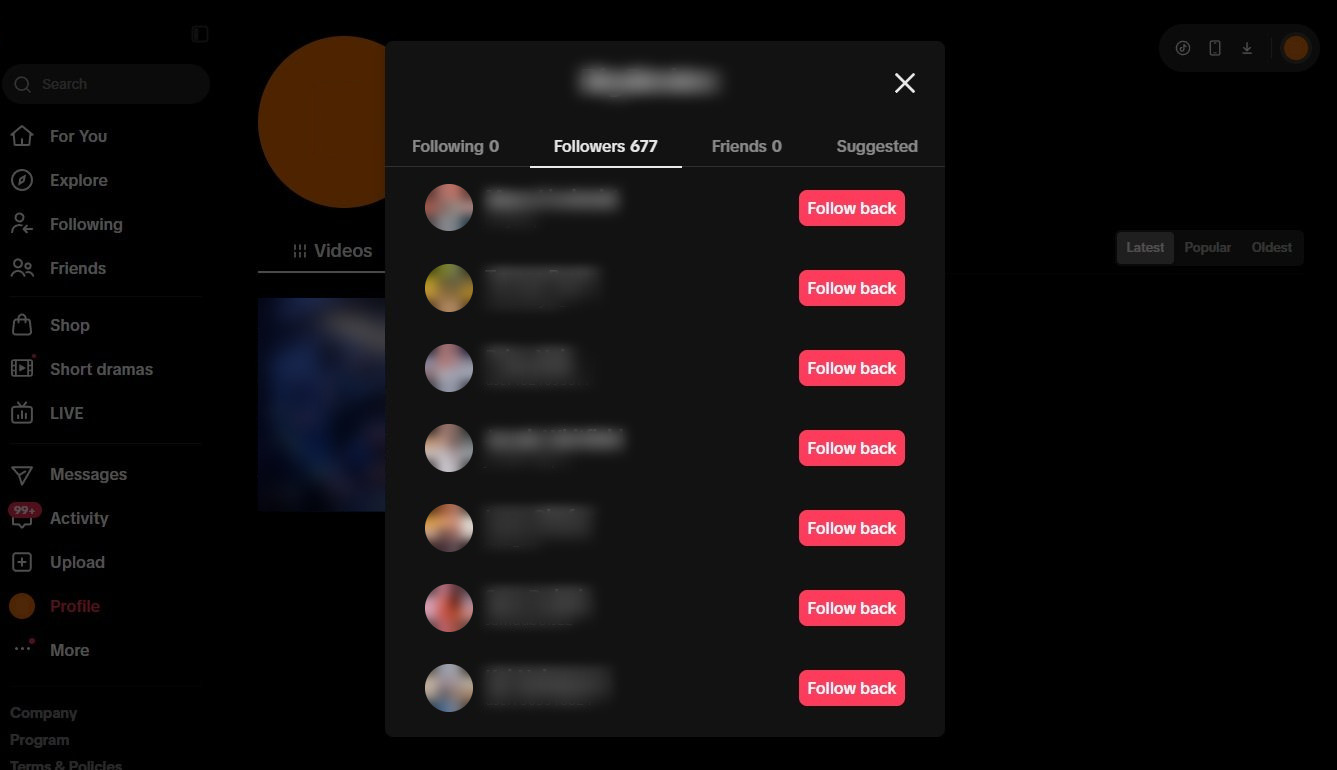
This is particularly relevant for TikTok users. As we documented in our guide on how to delete all TikTok videos, the platform makes it deliberately difficult to remove content in bulk. Users must delete videos one by one; this process often takes hours.
Similarly, our research on deleting all liked videos on TikTok revealed that the platform provides no native bulk deletion tool for likes, forcing users who want to clean up their digital footprint to spend hours manually unliking individual videos. Even for users that never post on TikTok, liked
These design choices are not accidental. They serve the same purpose as the addictive features at the center of the lawsuits: making it difficult for users to reduce their engagement with or presence on the platform.
Taking Control: Why Digital Hygiene Matters Now More Than Ever
Law and regulation are shifting, but meaningful change will take years. In the meantime, individuals can take immediate action to reclaim control over their digital presence.
The Case for Proactive Digital Cleanup
As scrutiny of social media intensifies, more users are recognizing the value of maintaining a cleaner digital footprint:
- Professional reputation management: Employers and clients increasingly review social media history
- Privacy protection: Reducing your digital footprint limits data exposure and potential misuse
- Mental health benefits: Studies show that reducing social media usage correlates with improved well-being
- Future-proofing: Content you post today may be searchable and quotable decades from now
The Challenge of Platform Lock-In
Social media companies have made it intentionally difficult to leave or reduce your presence. Beyond the addictive design that keeps you coming back, the actual mechanics of content removal are often cumbersome:
- No bulk deletion tools: Most platforms force manual, one-by-one deletion
- Hidden archive features: Downloaded data archives don’t always include everything
- Algorithmic persistence: Even after deletion, your data influences recommendations
- Incomplete removal: Platform backups and caches may retain deleted content
Redact.dev: Built for the Privacy
As awareness grows about the hidden costs of prolonged social media engagement, tools that enable meaningful digital control become essential. Redact was built specifically to address the gap between users’ desire for privacy and platforms’ resistance to enabling it.
Comprehensive TikTok Management
For TikTok users concerned about their digital footprint, Redact provides:
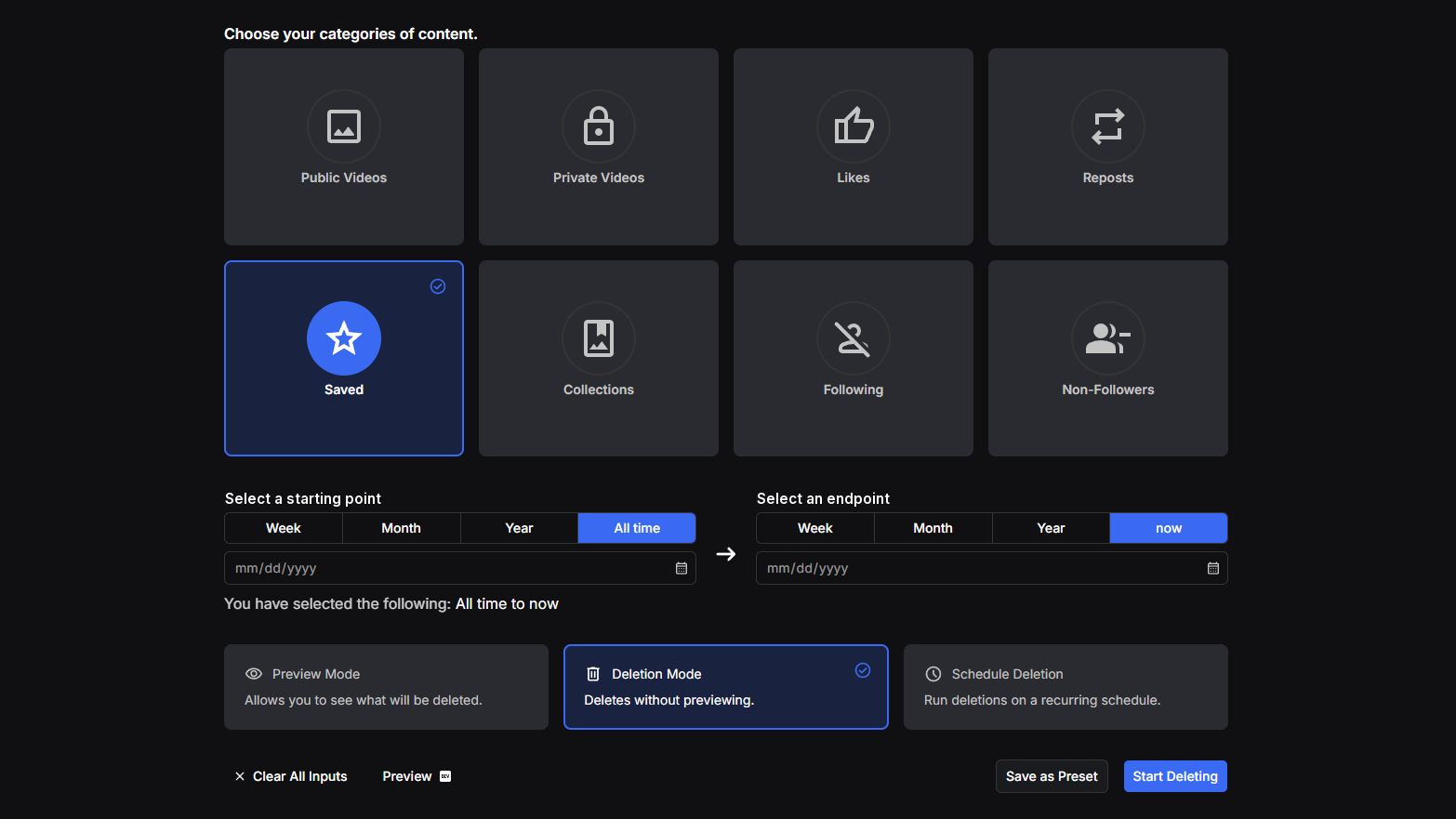
- Bulk video deletion: Remove all your TikTok videos at once, not one by one
- Automated unliking: Clear your entire liked video history efficiently
Redact supports TikTok alongside major platforms including Twitter/X, Reddit, Discord, Facebook and Instagram, 35+ in all, from a single interface.
Why Automation Matters
The time investment required to manually clean up years of social media activity is deliberately prohibitive. Platforms know that if removing content takes hours or days, most users simply won’t do it. This is where automation becomes not just convenient, but necessary for meaningful digital control.
Privacy-First Design
Unlike social media platforms that profit from collecting and analyzing your data, Redact operates on privacy-first principles:
- Local processing: Your data isn’t uploaded to third-party servers
- No data retention: Redact doesn’t store your social media content or credentials
- Transparent operations: You control what gets deleted and can review before taking action
The Broader Implications: Beyond Individual Action
While tools like Redact help individual users, the TikTok settlement and ongoing trial represent a larger, fundamental reckoning with how social media has been designed and deployed over the past two decades.
The Big Tobacco Parallel
Legal experts and plaintiffs’ attorneys have explicitly compared this litigation to the tobacco industry lawsuits of the 1990s. The parallels are striking:
- Internal knowledge of harm: Just as tobacco companies knew cigarettes were addictive and harmful, evidence suggests social media companies were aware of negative mental health impacts
- Targeting vulnerable populations: Both industries were accused of specifically targeting young people to create lifelong customers
- Manipulation over transparency: Design choices prioritized engagement over user wellbeing
- External costs: Society bears the healthcare and social costs of addiction
The 1998 tobacco Master Settlement Agreement required companies to pay billions in healthcare costs and restricted marketing to minors. If this litigation succeeds, we could see similar outcomes for social media companies, potentially including:
- Billions in damages paid to states and individuals
- Mandatory changes to addictive design features
- Restrictions on targeting minors with personalized content
- Required warnings about mental health risks
- Independent oversight of product design decisions
What Victory Would Mean
If plaintiffs prevail against Meta and YouTube, the implications would be profound:
For tech companies: A loss would establish that addictive design can create legal liability, forcing a complete rethinking of engagement-optimization strategies. Companies would need to balance user retention against potential legal exposure.
For users: Successful litigation could lead to platforms that are designed with user well-being rather than pure engagement in mind. Features like chronological feeds, usage limit tools, and easier account management might become standard.
For regulators: A plaintiff victory would embolden lawmakers worldwide to impose stricter regulations, knowing that courts are willing to hold platforms accountable for design choices.
For future plaintiffs: Success would create a roadmap for additional lawsuits targeting other harmful design patterns, from algorithmic radicalization to privacy-invasive data collection.
What Defeat Would Mean
Conversely, if Meta and YouTube successfully defend against these claims, the outcome would still be significant:
Not a return to status quo: Even if the companies win, they face an increasingly hostile regulatory environment worldwide. As Cato Institute fellow Eric Goldman notes, social media companies will still face an uphill battle in an unfavorable legal climate.
Pressure for legislative action: A defense victory might simply shift the battleground from courts to legislatures, with lawmakers potentially passing laws specifically designed to hold platforms liable for design-based harms.
Continued erosion of Section 230: Regardless of this case’s outcome, courts are increasingly willing to limit Section 230’s protective scope, particularly where product design rather than content is at issue.
The Emerging Consensus: Design Matters
Perhaps the most important takeaway from this litigation is the growing recognition that how platforms are designed matters just as much as what content appears on them.
For years, debates about social media harm focused almost exclusively on content: misinformation, hate speech, explicit material. The implicit assumption was that if platforms could effectively moderate harmful content, users would be safe.
These lawsuits represent a fundamental challenge to that assumption. Even if every piece of content on a platform is benign, the addictive design patterns (infinite scroll, personalized algorithms, notification systems, social validation mechanics) can still cause significant harm.
This shift in focus has implications far beyond social media. As Bloomberg Law has reported, product liability theories targeting inherently addictive design are increasingly moving forward in courts, especially when evidence shows intentional or reckless disregard for child safety.
Looking Ahead: 2026 and Beyond
The current trial is just the beginning. Additional major cases are scheduled throughout 2026:
- June 2026: Federal bellwether trial in Oakland, California representing school districts suing social media platforms
- Ongoing: More than 40 state attorneys general pursuing separate litigation against Meta
- Multiple jurisdictions: TikTok faces lawsuits in more than a dozen states
- International: Regulatory investigations and potential litigation in the EU, UK, and other jurisdictions
The Social Media Victims Law Center, which represents plaintiffs in many of these cases, has indicated that hundreds of additional families and school districts are part of the litigation, with new cases being filed regularly.
What You Can Do Now
While litigation and regulation proceed, there are concrete steps you can take today:
1. Set Boundaries with Social Media
Recognize the addictive design patterns and counteract them:
- Use app timers and Screen Time features
- Turn off non-essential notifications
- Set specific times for social media checking rather than reactive scrolling
- Consider deleting apps from your phone and accessing via desktop only
2. Audit Your Digital Footprint
Review what you’ve posted, liked, and commented on across platforms. Consider:
- Content from years ago that no longer represents your views
- Information that could affect professional opportunities
- Personal details that could compromise privacy or security
3. Protect Your Data
Use available tools to actively manage your digital presence:
- Download your data archives to understand what platforms have stored
- Delete old posts, comments, and likes systematically
- Consider tools like Redact for efficient bulk deletion
- Regularly review and update privacy settings
4. Stay Informed
Things are changing fast. Follow developments in:
- Ongoing litigation and trial outcomes
- New regulatory initiatives in your jurisdiction
- Emerging research on social media’s impacts
- Platform policy changes in response to legal pressure
Conclusion: A Turning Point for Digital Privacy
TikTok’s decision to settle rather than face trial, combined with Snapchat’s similar choice last week, suggests these companies recognize the strength of the evidence against them. The fact that Meta and YouTube are proceeding to trial indicates this will be a closely watched, high-stakes legal battle.
Regardless of the trial’s outcome, the era of unchecked social media growth appears to be ending. The combination of litigation, regulation, and growing public awareness is forcing a reckoning with how these platforms have been designed and operated.
For users, this moment represents both a challenge and an opportunity. The challenge is recognizing how addictive design has shaped our relationship with social media and the digital footprints we’ve created. The opportunity is to take proactive steps to reclaim control over our digital presence.
The tools and legal frameworks for meaningful privacy protection are finally emerging. The question is whether users will take advantage of them; and whether companies will be compelled to fundamentally rethink how they design products that billions of people use every day.
As this landmark litigation unfolds, it’s clear the conversation about social media harm has moved beyond content moderation to the core question of how platforms are designed. And that shift may prove to be the most significant legacy of this case, regardless of the jury’s ultimate verdict.
About Redact: Redact is a privacy-first digital footprint management tool that helps users efficiently delete and manage content across major social media platforms including TikTok, Twitter/X, Reddit, Discord, Facebook, and Instagram. Learn more about deleting TikTok content or managing your liked videos on our blog.