There are two forms here and they aren't alternatives. The mailings opt-out is open to everyone, in every state, but only covers mail Share Local Media sends for itself. Its policy says it doesn't affect mailings facilitated for clients, so a client catalogue can keep arriving until you ask that client. The consumer rights form deletes what they hold. It asks your state first, and for most states answers "There are no available request types for your state."
Background first? The Share Local Media profile covers who they are, where your address came from, and the nineteen states their rights form recognises.
None on either form · Share Local Media reports a one-day median for deletion requests in its California filing
Do the mail opt-out even if the rights form turns you away. They're separate systems doing separate jobs, and a refusal on one has no bearing on the other.
Step one
Stop the mail
The part that works for everyone.
01
Open the mailings opt-out
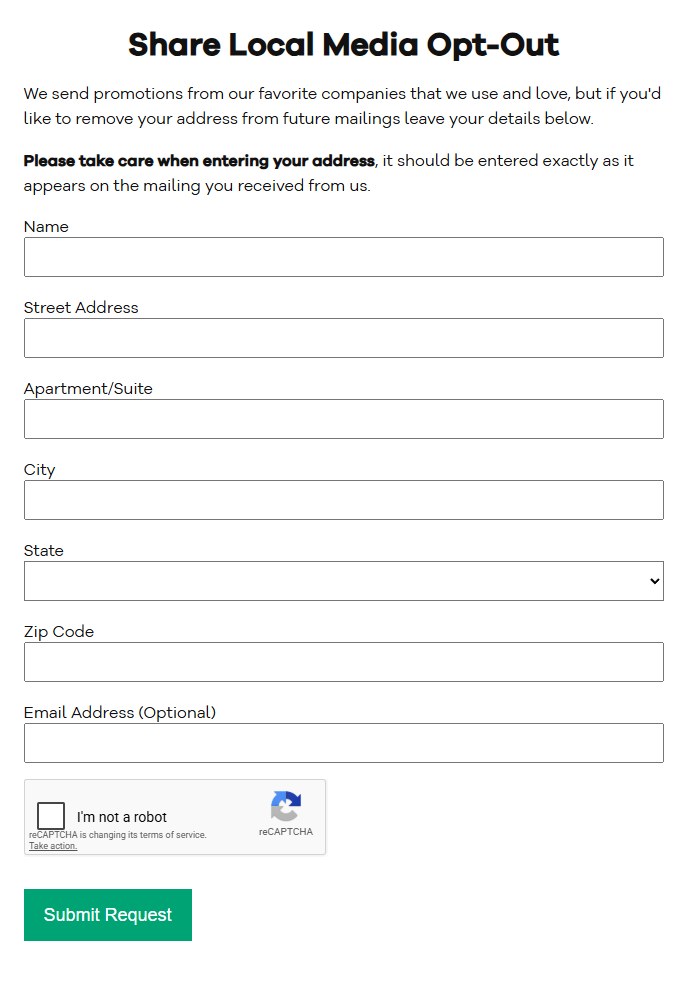
Go to opt-out.sharelocalmedia.com. The page is headed Share Local Media Opt-Out and asks for your name, street address, apartment or suite, city, state, zip code and, optionally, an email address. A reCAPTCHA box sits before the Submit Request button.
The state field here is just part of your address. It gates nothing, and every state is accepted.
The mailings opt-out. No state gate, no ID, no account.
Type the address exactly as it appears on the mail they sent you. The page asks you to, in bold, and it isn't a formality. Their file is keyed to the address, so "Apt 4" against their "#4", or a street abbreviated differently, can match nothing and achieve nothing.
02
Fill it in from the envelope, not from memory
Dig out a piece of the actual mail if you still have one and copy the address block across as printed, including any name variant. If it's addressed to a version of your name you'd never use, use theirs. You're matching their record, not describing yourself.
The email field is optional, but filling it in gives them a way to reach you about the request, and nothing else here produces a receipt.
03
Submit, and keep your own evidence
Complete the reCAPTCHA and press Submit Request. Screenshot the filled form first and note the date, because there's no reference number and nothing to log into afterwards.
If their mail is addressed to more than one person in your household, submit once per name. The file is a list of addressed records, not of households.
Step two
The rights form, and the state question
This form reaches the data rather than the envelope. Whether it does anything for you depends entirely on which state you live in.
01
Open the consumer rights form
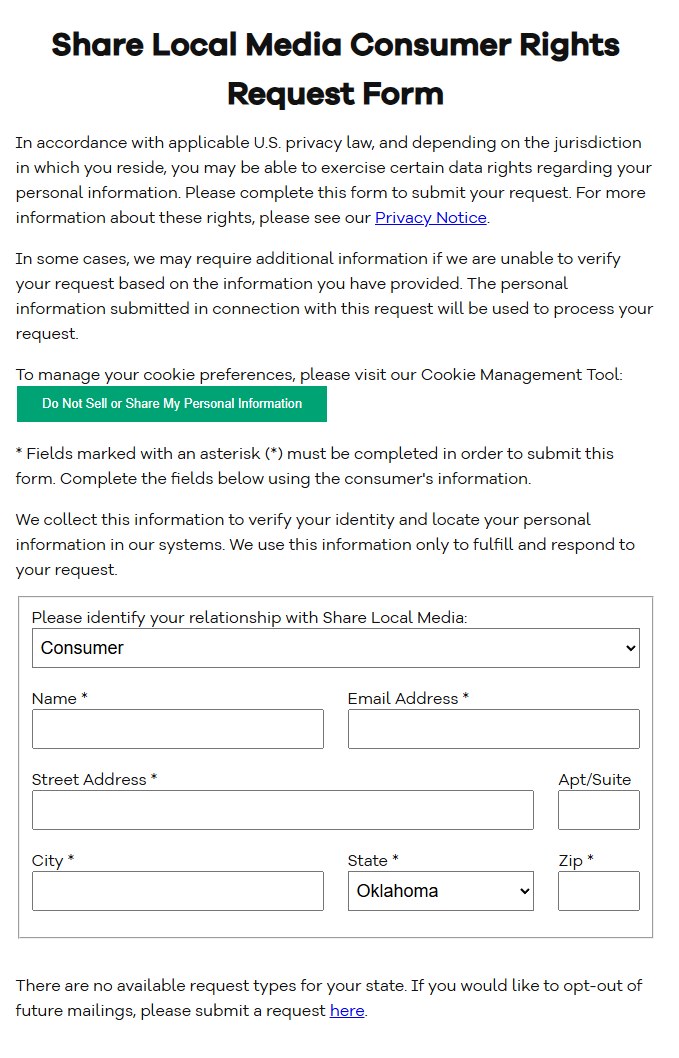
Go to privacy.sharelocalmedia.com, headed Share Local Media Consumer Rights Request Form. It opens with a relationship dropdown, defaulted to Consumer, then requires your name, email address, street address, city, state and zip. Apartment or suite is optional. Its own explanation is candid. It collects this to verify your identity and locate your personal information in our systems.
02
Choose your state, and watch what happens
The state dropdown is the whole story. Pick a state with a consumer privacy law and the form offers request types for knowing what they hold, correcting it, deleting it, and opting out of sale or sharing.
Pick a state without one and the form answers:
There are no available request types for your state. If you would like to opt-out of future mailings, please submit a request here.
That's the entire response. No rights, and a link back to the form you've already done.
Oklahoma selected. No request types, and a redirect back to the mail form.
This is what a state privacy law is worth, made visible. Nothing unlawful is happening. The company offers exactly the rights it's required to offer and no more, and the dropdown is where that decision meets you.
03
If your state is served, ask for deletion
The nineteen states the policy recognises are California, Colorado, Connecticut, Delaware, Indiana, Iowa, Kentucky, Maryland, Minnesota, Montana, Nebraska, New Hampshire, New Jersey, Oregon, Rhode Island, Tennessee, Texas, Utah and Virginia.
If you're in one, request deletion rather than only opting out of sale, since deletion addresses the record itself. In Oregon or Minnesota you can also request a list of the specific third parties your information went to, which tells you who else to go after. The policy says a refusal comes with reasons, and that appeals, where your state allows one, go back through this same form.
If you're refused
What to do when your state has no options
Being told there are no request types for your state isn't the end of it. The mail can be stopped. The stored record is a harder ask, because you no longer have a form that will take the request.
What you still have is a company with published contacts and no rule against asking. The policy names legal@sharelocalmedia.com for privacy questions and (904) 543-3803 for rights requests, and its California filing lists privacy-team@sharelocalmedia.com. A polite, specific email asking them to delete what they hold about you, quoting your address exactly as printed on their mail, costs five minutes. They aren't obliged to agree, and you won't know whether they apply their privacy programme nationally without asking.
While you're here, DMAchoice is the advertising industry's own mail suppression service, run by the ANA, and the FTC's donotcall.gov covers the phone. Neither replaces opting out here, but both cover far more than one broker.
Keep the screenshot of the refusal. A dated picture of a company telling you your state entitles you to nothing is useful whether you end up escalating, complaining, or writing to whoever represents you.
Confirm
Check it worked
There's nothing to log into and no listing to search, so confirmation is simply whether the mail stops.
Give it six to eight weeks. Direct mail is printed well in advance, so post already in the pipeline keeps arriving for a while after a suppression is accepted, and that doesn't mean the request failed. After two months, see the troubleshooting below.
If it fails
Troubleshooting
Mail still arriving after two months. Compare the envelope's address block against what you typed. An abbreviation or a missing apartment number is enough to miss. Re-submit copying the envelope exactly.
Addressed to a name you don't use. Submit again using their version of the name. You're matching their record, not correcting it.
"There are no available request types for your state." Expected outside the nineteen listed states. Do the mailings opt-out, then email legal@sharelocalmedia.com asking for deletion anyway.
The rights form won't accept your request. The policy lets them decline where they can't verify you or locate your data. Include the address exactly as printed on their mail.
Mail from a brand, not from Share Local Media. The policy says the mailings opt-out doesn't cover mail it facilitates for clients. Ask that brand directly to remove you.
You'd rather speak to someone. (904) 543-3803 is named in the policy as a route for privacy requests.
Several people at your address get the mail. Each addressed name is a separate record. Submit once per name.
Staying off
Keeping it from coming back
Share Local Media doesn't generate your address, it buys it. A suppression here stops this company mailing you while doing nothing about the source that sold your details, which is free to sell them again next quarter. So the useful habit is treating new unsolicited mail as a signal that your address is circulating, and dealing with it through the industry suppression lists rather than one sender at a time.
The exception is moving house. A change of address is what refreshes these files, so a suppression tied to your old address won't protect your new one. If you move, do this one again with the new address, before the mail starts.
Take yourself off data broker sites
Redact scans data broker sites from your device, finds where your details are listed, and submits the removal requests for you. If a broker relists you, it files again.
August 18, 2026 · Both forms walked firsthand. Both refuse automated readers outright, so the field lists below come from the walk itself. The state refusal was reproduced by selecting Oklahoma.
September 10, 2026 · Rechecked. Both forms still answer a Cloudflare challenge to anything scripted, so nothing below could be re-read from served HTML and the walk's account stands. The policy, effective January 1, 2026, still limits the mailings opt-out to the Shared Mail Program, lists the same nineteen states, and now routes appeals through the rights form. The California registry row still shows the same deletion figures.