
Removal guide · Government Registry

How to remove your info from Government Registry

  • Redact removes listings automatically

Short flow, hard limit. Government Registry's opt-out is a search - the name, city, and state on your listing locate it, a red Remove my Data button claims it, and an optional email plus a reCAPTCHA submits it. Confirmed by a real walkthrough on August 12, 2026, and the request was approved instantly. The limit is the state list. The form only searches listings in nineteen states, the ones with consumer-privacy laws (Florida is in the site's rights notice but not in the dropdown, as of September 10, 2026). A listing under an address anywhere else never comes up, and for that one the site's contact form is the manual route.

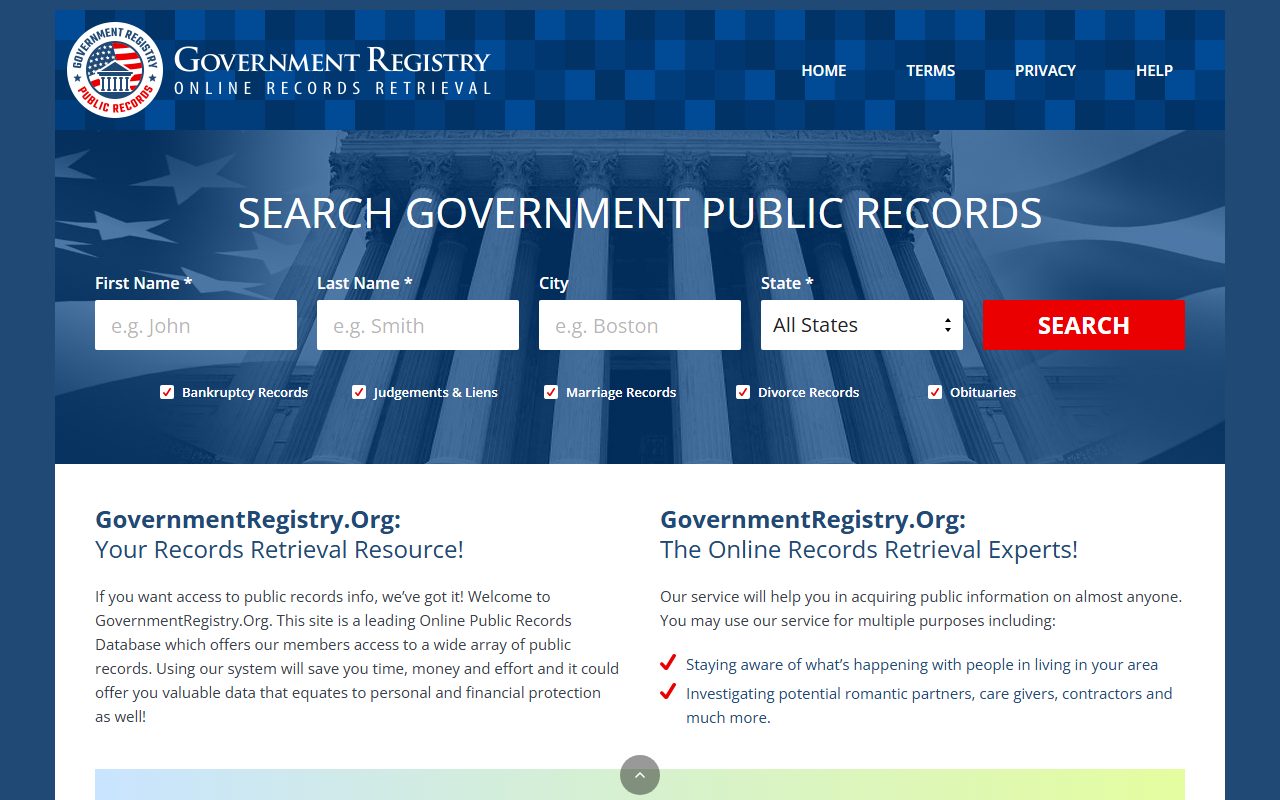
Government Registry homepage screenshot

The full picture: See the Government Registry profile for the state list and the official-sounding-name warning.

Quick facts

At a glance

Method

Search → Remove my Data → optional email + reCAPTCHA

What it can reach

Listings in 19 privacy-law states - the dropdown on September 10, 2026

Where you live

Not asked · the state is the listing's, not yours

Time needed

About 3 minutes - approval was instant on our walk

Cost

Free

Turnaround

Instant on our walk · prompt-acknowledgment promise in the fine print

Listing in another state?

Contact form - the manual route

The steps

Remove your listing

Confirmed by a real walkthrough on August 12, 2026 - three screens, screenshotted as walked.

Government Registry's Your Privacy Rights by State notice listing the twenty states whose residents may have privacy rights under state law
The site's own rights notice, twenty states long. The form's dropdown offers nineteen of them - Florida is on this list and not in the form.
01

Search for your listing

Go to governmentregistry.org/opt-out - the Your Privacy Choices page. The Remove my Personal Information form is a search, first name, last name, city, and state, all required, then the green SEARCH. Enter the city and state your listing shows, which may be an old address rather than where you live now. The dropdown is the limit - on September 10, 2026 it offered nineteen states (California, Colorado, Connecticut, Delaware, Indiana, Iowa, Kentucky, Maryland, Minnesota, Montana, Nebraska, New Hampshire, New Jersey, Oregon, Rhode Island, Tennessee, Texas, Utah, Virginia), and a listing in any other state can't be searched. Florida is the strange case, named in the rights notice further down the page and missing from the dropdown.
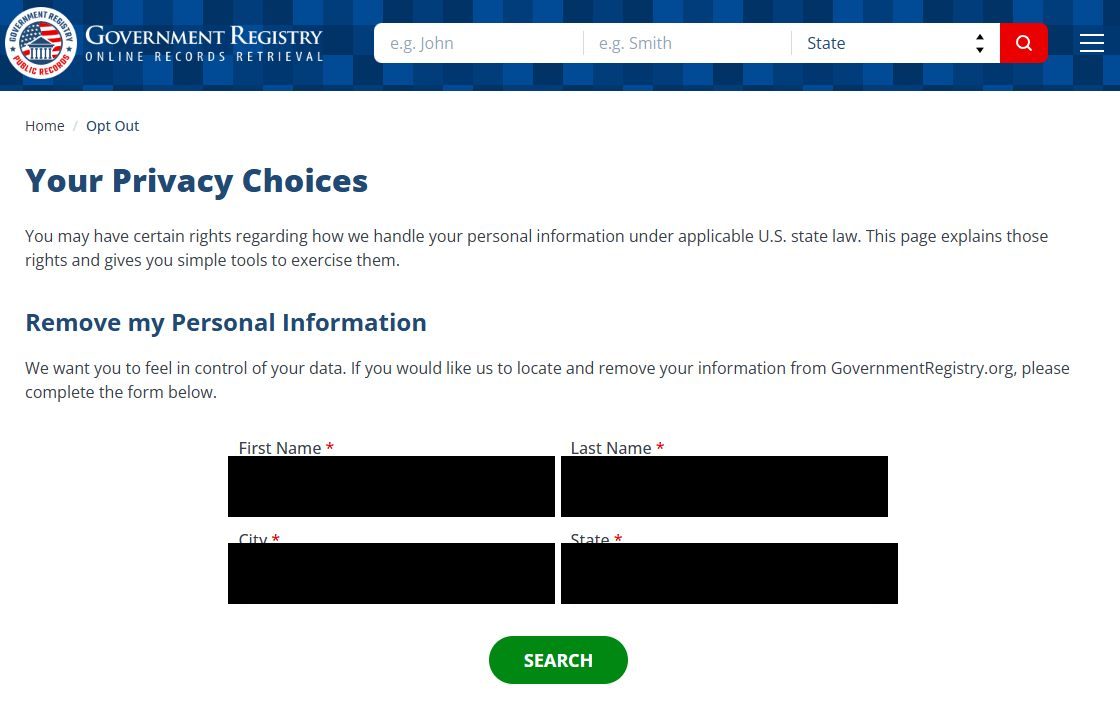
Government Registry's Your Privacy Choices page with the Remove my Personal Information search form - required first name, last name, city, and state fields and a green SEARCH button
The opt-out starts as a search - and only nineteen states are in the dropdown.

Listing's state not in the dropdown? The site's contact form is the manual route - ask for removal in writing, quote the listing's details, and keep a dated copy. No statute compels them to act on it, but it's the channel that exists.
02

Pick your record and push Remove my Data

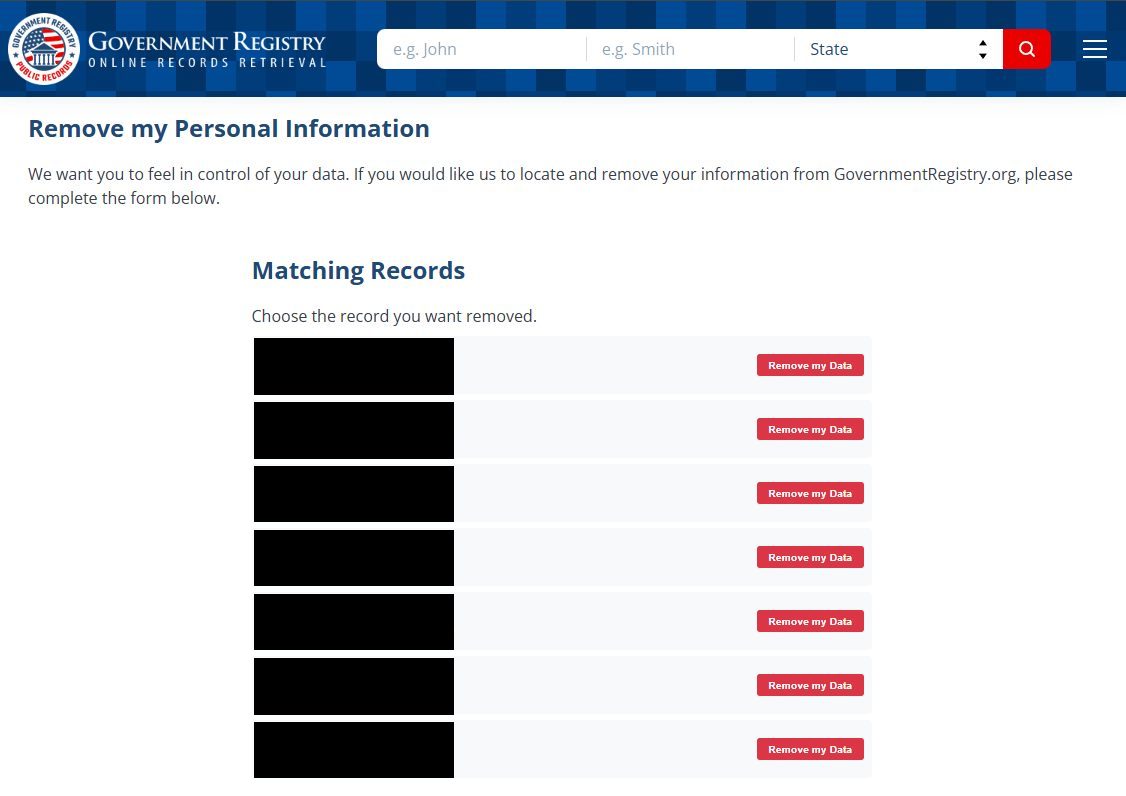
The Matching Records list shows each candidate as a name and street address with a red Remove my Data button. Common names stack up - one search on our walk returned seven same-name records in a single city - so match on the address before pushing the button on the record that's you. One button claims one record, so old addresses and name variants are their own removals.

Government Registry's Matching Records list showing several same-name records with street addresses, each with a red Remove my Data button
Match on the address - each record gets its own Remove my Data button.
03

Add an email if you want a receipt, then submit

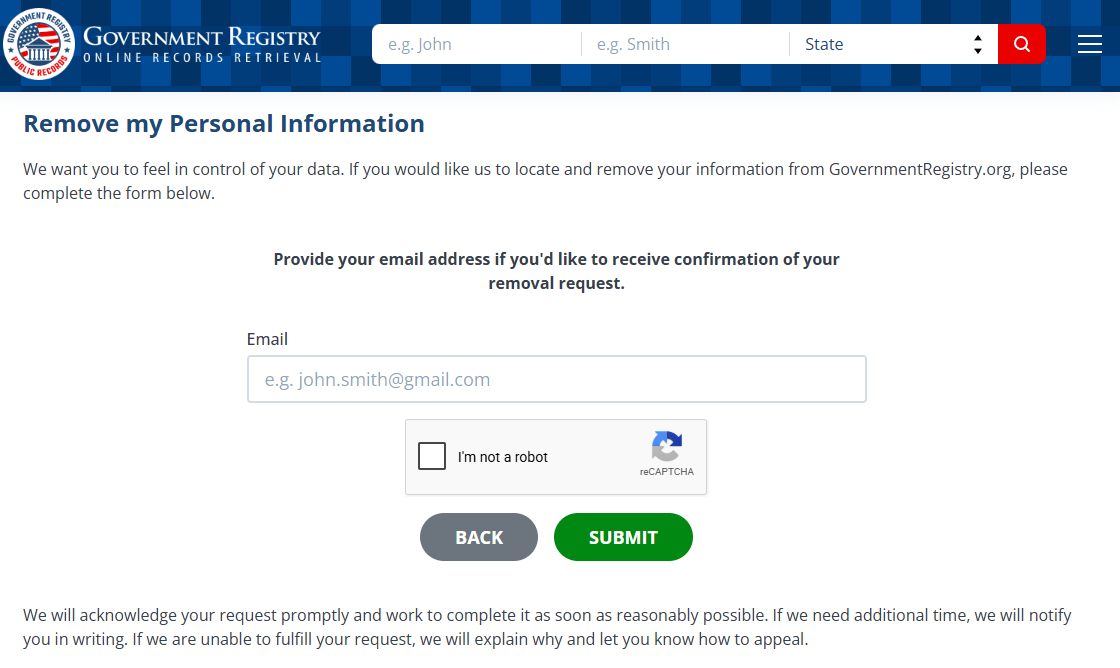
The last screen asks for your email address - optional by its own copy, "Provide your email address if you'd like to receive confirmation of your removal request." Give one anyway; it's the only receipt this flow produces. Tick the I'm not a robot reCAPTCHA and push SUBMIT. The fine print promises prompt acknowledgment, written notice if they need more time, and an explanation with an appeal route if they refuse - and on our walk the request was approved instantly.

Government Registry's final removal screen asking for an optional email address for confirmation, with an I'm not a robot reCAPTCHA and BACK and SUBMIT buttons
Email optional, reCAPTCHA required - approval was instant on our walk.

Confirm

Confirm it worked

Search your name on the site again after a day or two - approval was instant on our walk, so a listing that survives is a signal, not a delay. If you gave an email, keep the confirmation as your record. If the listing persists, rerun the flow, and failing that put a written request through the contact form - the site's own fine print promises an explanation and an appeal route when it refuses a request.

Stay off

Keep your record off

Aggregator sites rebuild from fresh public-records feeds, so recheck quarterly, and search every address you've held in the nineteen states, not just the current one. If a listing sat in a state the form couldn't search, recheck the form's dropdown from time to time - its list follows the state privacy laws only loosely and changes without notice, so a law taking effect doesn't guarantee the state appears. Redact's data-broker scan automates the recheck loop.

Take yourself off data broker sites

Redact scans 120+ data broker sites from your device, finds where your details are listed, and submits the removal requests for you. If a broker relists you, it files again.

Last updated:

September 10, 2026 · Opt-out page reread live. The dropdown now offers nineteen states and Florida has dropped out of it, while the rights notice on the same page still lists twenty. The form asks for the listing's city and state and never asks where the requester lives. The flow was confirmed by a real walkthrough on August 12, 2026 - three step screenshots plus the site's own state-rights notice wired in. That walk replaced the drafted flow with the real one, a search (name, city, state) → Matching Records → red Remove my Data → optional email + reCAPTCHA, found no confirmation-email dependence, and had the request approved instantly.