Removal guide · Carney Direct

How to remove your info from Carney Direct

Carney Direct gives you two routes that do different jobs, and most people only find one. The on-site form is a state-privacy-rights request keyed to your name and email. Getting out of the marketing databases takes a separate email to privacy@carneydirect.com with your mailing address, which the form never asks for and which the privacy policy requires before Carney Direct will verify you at all. Do both. Neither costs anything and neither needs an account.

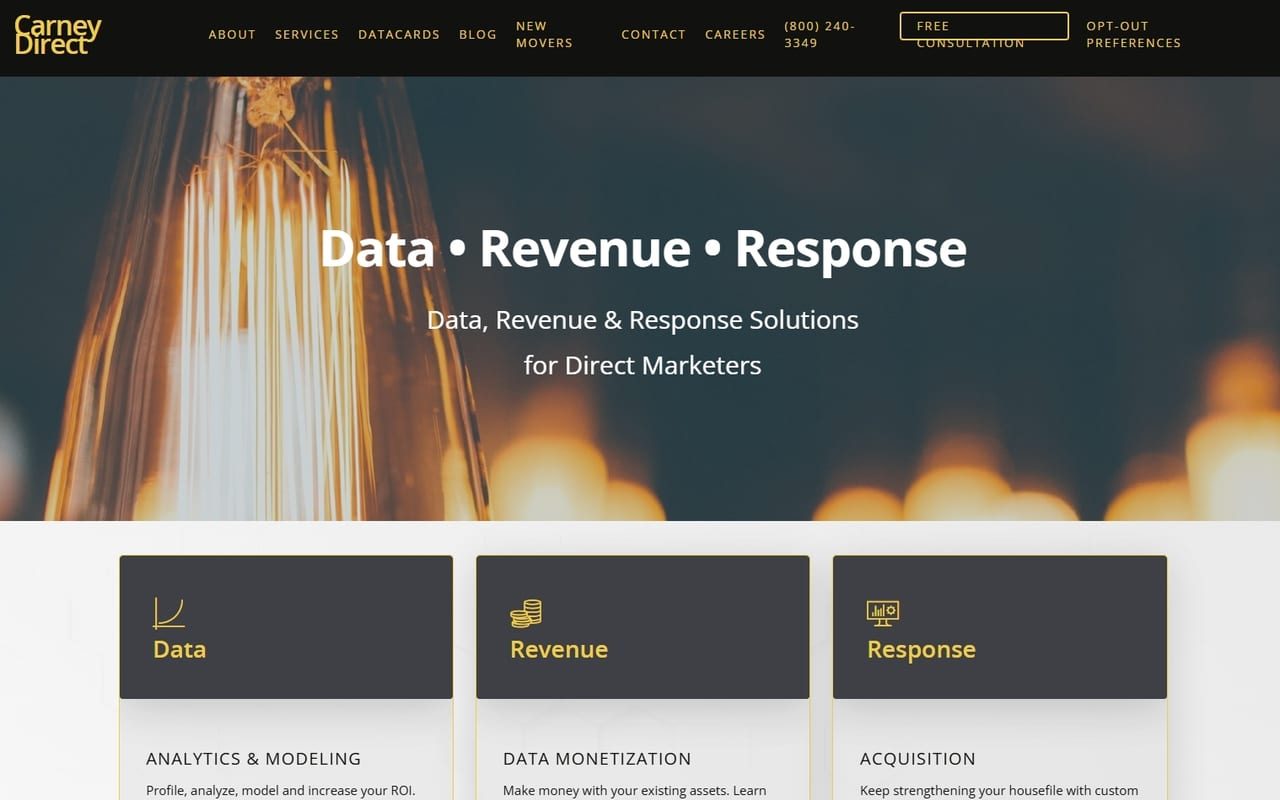
Carney Direct homepage screenshot

Some background first? The Carney Direct profile covers who runs it, why the registry files it under a different company name, and the numbers in its own compliance table that don't line up with its registry filing.

At a glance

What this takes

Cost

Free

Time

About five minutes for both routes together

Account needed?

No

Method

On-site rights form plus an email to the privacy address

Identity proof

Not asked up front · the page warns you "may need to provide additional identifying information"

CAPTCHA

None in the form's served HTML

Marketing database

privacy@carneydirect.com · needs your mailing address

Stated turnaround

None promised · Carney Direct's own 2025 table reports a 6.63-day average and its 2024 registry filing 11 days

Can you verify it worked?

No · there's no consumer search here to check yourself against

The form alone won't take you off a mailing list. It collects a name and an email. A direct-mail file is keyed to a postal address. Carney Direct's own privacy policy points marketing-database removals at the email route instead, and asks for your mailing address there. If you only do one of the two, you've done the one that doesn't reach the mail.

Route one

Submit the rights form

01

Open the opt-out preferences page

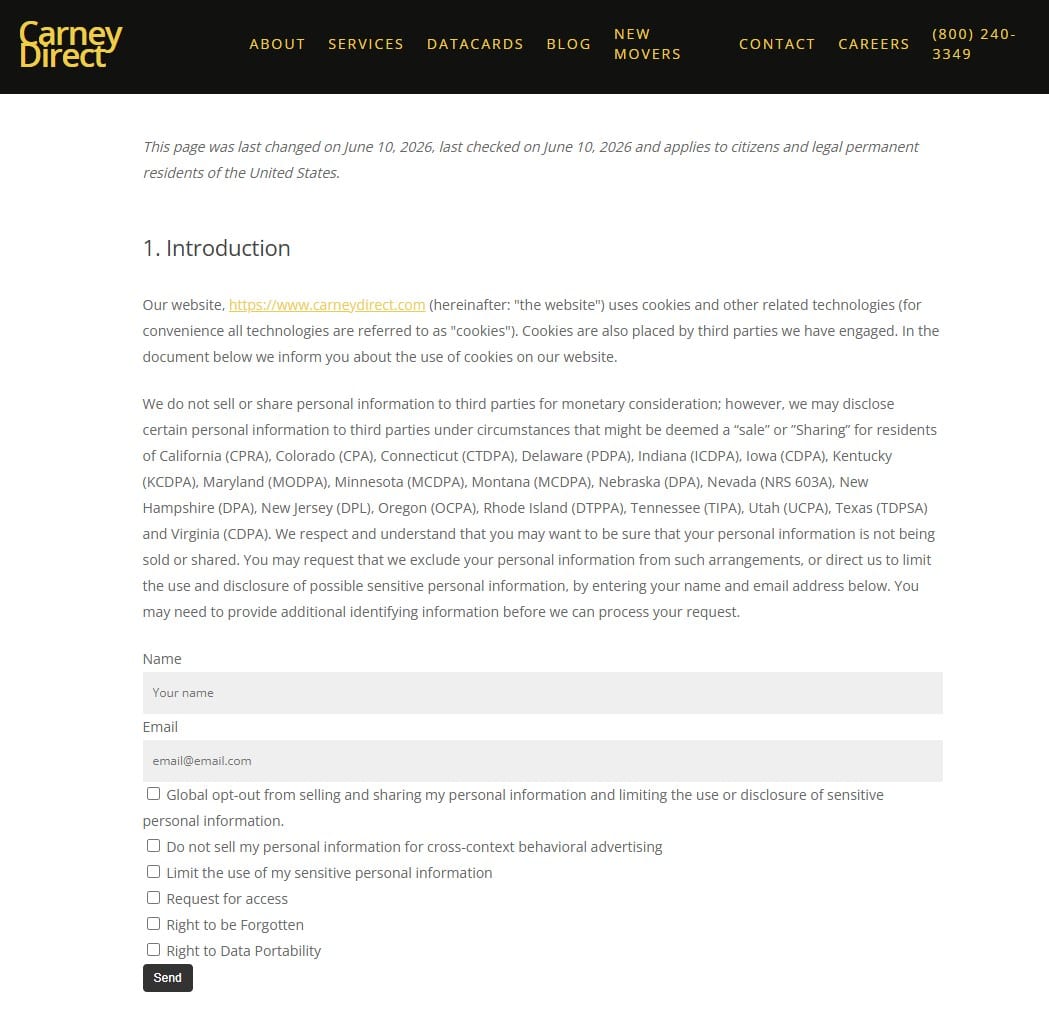
Go to carneydirect.com/opt-out-preferences. Above the form sits a paragraph naming twenty states whose residents it says may be affected by disclosures that could count as a sale or sharing, and a line stating the page applies to citizens and legal permanent residents of the United States. Read the eligibility section below before you decide which route to use.

Carney Direct opt-out preferences page listing twenty state privacy statutes, above a form with Name and Email fields and six unticked request checkboxes ending in a Send button
The whole form. Two fields, six checkboxes, none of them ticked for you.
02

Type your name and email by hand

Name and email are the only required fields. Fill them yourself rather than letting the browser autofill them, because the page carries a second name field it doesn't show you, of the kind sites use to catch bots by seeing whether anything fills a box a human never sees. Password managers and aggressive autofill do sometimes fill invisible fields. Typing the two boxes manually costs you nothing and removes the risk.

Use an address you can still read in six months. There's no confirmation you can look up later on this site, so the sent mail in your own outbox is the record. A masked or forwarding address is fine, but not a burner you'll lose access to.

03

Tick the boxes, because none of them are ticked

All six start empty, and the Send button works with none of them selected, which would send Carney Direct your name and email while asking for nothing at all. In page order they're

  • Global opt-out from selling and sharing your personal information, and limiting use and disclosure of sensitive personal information
  • Do not sell my personal information for cross-context behavioural advertising
  • Limit the use of my sensitive personal information
  • Request for access
  • Right to be Forgotten
  • Right to Data Portability

If you simply want out, the first and the fifth are the ones that matter. Request for access is worth ticking anyway. It costs nothing extra and it's the only way to ask what they hold, which is otherwise unknowable on a site with no consumer search. It's a request rather than a guarantee, since the policy makes any disclosure conditional on verifying your identity first.

04

Send, and keep your own record

Press Send. The request goes through the site's own privacy plugin rather than to a page that gives you a reference number, so screenshot the completed form before you send it and note the date. Watch the screen afterwards too. The plugin writes its result into a message area on the page, so capture that as well if it appears. Between them, those two screenshots are your evidence for this route.

Route two

Email to get out of the marketing databases

This is the route the form doesn't cover, and it's the one that reaches the file that gets rented out.

Carney Direct's privacy policy says that to opt out of its marketing products and services databases you email privacy@carneydirect.com with your full name, mailing address, email address and telephone number. That list isn't arbitrary. Those are the four keys a direct-mail file is indexed on, and supplying all four is what lets them find every record rather than the one that happens to match your email.

Write plainly. Say you're asking to be removed from Carney Direct Marketing's marketing products and services databases, give the four identifiers, and add any previous address you've lived at in the last few years. A new-mover file is built on the fact that you moved, so an old address may be the one it holds.

The policy says a verified opt-out moves your record from the marketing databases into a suppression database that keeps you out, and that Carney Direct may ask you to verify what you sent, for instance by replying to an email, before it acts. The same policy names a postal alternative at Carney Direct Marketing, Attn: Privacy Officer, 10 Hughes, Suite A201, Irvine, CA 92618, and a toll-free line on (800) 240-3349.

Yes, you have to give them an address to get off an address list. It reads backwards and it's a fair thing to resent, but a suppression file works by matching, and there's nothing to match on without it. Give the addresses, give nothing more, and never send a Social Security number, a driver's licence number or a scan of a document. Nothing in the published process asks for any of those.

Eligibility

The twenty states, and what it means if you're not in one

The opt-out page builds its whole framing around residents of twenty states with privacy statutes. California, Colorado, Connecticut, Delaware, Indiana, Iowa, Kentucky, Maryland, Minnesota, Montana, Nebraska, Nevada, New Hampshire, New Jersey, Oregon, Rhode Island, Tennessee, Texas, Utah and Virginia.

Be clear about what that is and isn't. It's a statement of where Carney Direct believes its legal obligations bite. It's not a statement that it will refuse anyone else, and nothing on the page says it will. But it's also not an offer to anyone else, and the form gives you no way to say where you live. The only region field on it is hidden, and it's fixed to us for everybody.

If you're in one of the twenty, submit the form and name your state and its statute in your email as well. You have a specific law behind you and it's worth saying so.

If you're not, the form still submits, but the email route is the better use of your time, because an email has room for you to make the request in your own words rather than as a checkbox on a page written for somebody else.
This pattern is worth recognising elsewhere. When a company enumerates the states it will honour, the practical effect is often that residents of the other thirty get less, whatever the page technically promises. Share Local Media, another direct-mail broker, lists nineteen and its rights form offers some states no request types at all. It's not a reason to skip the request. It's a reason to send it in writing, say where you live, and keep what you sent.

Confirm

What you can and can't check

Be realistic about this one. Carney Direct runs no consumer search, so there's no listing to refresh and no page that will tell you the record is gone. Searching your own name tells you nothing either way.

What you can do is make the access request work for you. If you ticked Request for access on the form, or asked for the same thing in your email, their reply is the only window you'll get into what they hold. If a reply comes and says nothing about what was on file, ask again and reference the access request specifically.

Otherwise the honest measure is indirect and slow. Whether the volume of unaddressed and newly-addressed mail drops over the following couple of months, particularly if you've moved recently.

If it fails

Troubleshooting

  • No acknowledgement of the form. It issues no reference number, but the privacy plugin it runs on has an on-page message area, so watch the screen after you press Send and capture whatever appears there. Screenshot the completed form beforehand regardless, since that's the half you control, and use the email route as the one that produces a reply you can keep.

  • No reply to the email after two weeks. Chase it once, then escalate in writing to the Privacy Officer at the Irvine address. A posted letter to a named officer is harder to lose than a second email into the same inbox.

  • They ask for more identification. The opt-out page warns that you "may need to provide additional identifying information before we can process your request", and the policy says verification may come as an email you have to answer. Give another address you've lived at, or a phone number already associated with you. Don't send identity documents to a list broker.

  • You're outside the twenty listed states. Send the email, state your residency plainly, and keep the copy. If it's refused, the refusal itself is a useful document.

  • California residents. The company files with the state registry as Guidestar Direct, Corp., so use that name in any complaint to the CPPA. A complaint naming only Carney Direct may not match the registrant.

  • Mail keeps arriving months later. Rented lists are already out of the door. A suppression stops future rentals; it can't recall a file a client licensed last quarter. Re-send the email if it continues past two or three months.

Staying off

Keeping it from coming back

The thing that puts you back into a file like this one is moving house. New-mover data is the product with its own place in Carney Direct's navigation, and change-of-address information flows into the industry from sources you never dealt with directly. A suppression you filed from your old address may simply not match the new record.

So the rule here is different from a people-search site, where quarterly rechecks make sense. Re-send the request when you move, and include both the old address and the new one so the match can be made either way.

Beyond this one company, the industry-level suppressions are worth the ten minutes. DMAchoice for postal mail, and the FTC's National Do Not Call Registry at donotcall.gov for the phone number you gave them. Carney Direct's own privacy policy points readers at both, which is a fair thing to note in its favour, and they cover far more than one broker.

Take yourself off data broker sites

Redact scans 120+ data broker sites from your device, finds where your details are listed, and submits the removal requests for you. If a broker relists you, it files again.

Last updated:

August 18, 2026 · Walked firsthand, then verified against the page's served HTML, which carries three things the rendered form doesn't show you. A hidden region field, a decoy name field, and six boxes that all start unticked. September 10, 2026 · Served HTML re-read. The page says it was last changed on June 10, 2026, so the walked version is the live one. Same fields, same defaults, name and email the only required inputs, no CAPTCHA script anywhere in the page, and the privacy policy (updated June 2026) still routes marketing-database removal to privacy@ with a mailing address.