Discord Bulk Deletions Surge 350% After Global ID Verification Announcement
 Dan Saltman6 min read
On this page
When Discord announced its global age verification rollout on February 9, user backlash was immediate. Within 48 hours, we observed a dramatic shift in behavior. Discord-related traffic to Redact surged 350%.
Update. Discord has since delayed the global age verification rollout to the second half of 2026. The advice below still applies, you just have more runway to act on it.
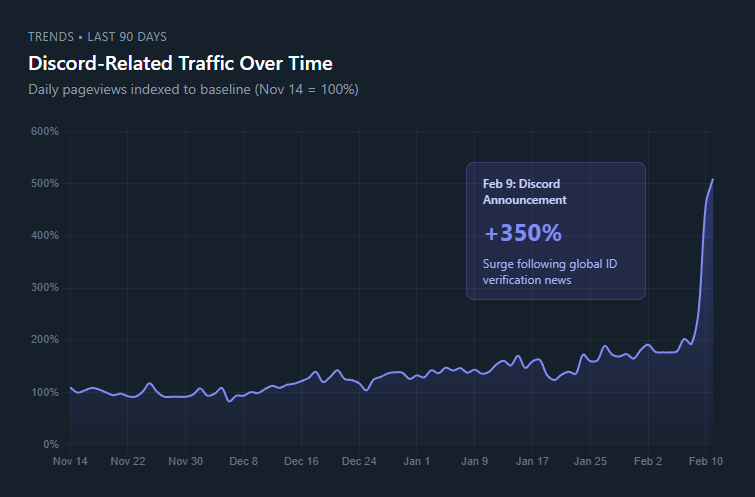
Beyond the push from Discord users to delete their data, there’s been a massive spike in search volume for “Discord Alternatives” identified by an X user via Google Trends. You can view this data here from Google.
The pattern is clear here. The global ID requirement announcement Discord published in February appears to be driving a mass exodus of active Discord users, and a huge increase in demand to wipe Discord data preemptively, before ID checks are implemented.
Why Users Are Deleting Now
As we’ve heard repeatedly from our community, if Discord is about to require identity verification, users want to minimize what’s attached to that identity first.
This concern isn’t hypothetical. Just four months ago, a breach of Discord’s third-party vendor exposed approximately 70,000 government IDs submitted through the age verification process. Discord is now rolling out a similar process, globally. A day after their statement, they clarified that a “minority” of users will actually need to complete age verification; most users will be exempt because their account history and activity will be used to “infer” their age with a machine learning model.
Users understand the math. The more data Discord holds (message histories, server memberships, connected accounts, behavioral patterns), the more catastrophic a potential breach becomes.
We’re seeing three distinct user motivations driving the surge.
- Pre-verification cleanup. Users who plan to verify are deleting old messages, embarrassing posts, or content they’d rather not have linked to their real identity. Think of it as digital housekeeping before inviting a guest who might remember everything.
- Exit preparation. Some users are deleting everything before abandoning Discord entirely. As TechRadar reported, many are actively searching for alternatives (which is independently verifiable via Google Trends). A clean exit means less data left behind.
- Breach risk mitigation. Given October’s incident, users may be calculating that any data Discord holds could surface in a future breach. Less data stored means less data exposed.
The Bigger Picture: Identity Verification Changes Everything
Discord’s age verification rollout represents a fundamental shift in how Discord operates. Until now, Discord accounts could be pseudonymous, with usernames disconnected from legal identities and messages tied to avatars rather than faces.
Once verification is required, Discord becomes a place where your real identity is on file. Every message, every server membership, every behavioral pattern can potentially be linked back to you as a verified individual.
For many users, this re-contextualizes years of accumulated Discord activity. Conversations that felt casual when pseudonymous feel different when attached to a verified identity. Posts made under the assumption of anonymity take on new weight.
This is why we’re seeing deletion activity surge before the verification rollout rather than after. Users want to address their historical footprint while they still can, before their accounts become formally identity-linked.
What This Means for Discord
Discord’s Head of Product Policy, Savannah Badalich, told The Verge the company expects “some sort of hit” to user numbers from this change. The deletion surge suggests that hit may be more significant than anticipated, and that it’s already beginning.
The users most motivated to delete are often power users: people with years of history, extensive server memberships, and deep engagement with Discord. These aren’t casual accounts being cleaned up. They represent Discord’s most active community members proactively reducing their investment in the service.
Whether Discord’s age inference model (the background system that estimates user age from behavioral signals) will reduce verification friction enough to stem the exodus remains to be seen. But the current data suggests significant user resistance to the new paradigm.
Secure Your Discord Account Before ID Verification Rolls Out
If you’re among the users reconsidering your Discord footprint ahead of the rollout, we recommend these steps.
- Audit your message history. Discord stores every message you’ve ever sent unless you manually delete it. This includes DMs, group chats, and posts in servers you may have left years ago. Consider whether you’re comfortable with that history being tied to your verified identity.
- Review server memberships. Your server list reveals interests, affiliations, and communities. Some users are leaving servers they’d rather not have associated with their real identity.
- Check connected accounts. Discord allows linking to outside services, like games, streaming apps, and social media. Review what’s connected and whether those links make sense post-verification.
- Use Redact to bulk delete. Manual deletion on Discord is tedious and incomplete. Redact lets you filter by keywords, channels, date range, or delete everything. You can preview before confirming and set up automated recurring cleanups.
- Decide your verification strategy. If you plan to stay on Discord, the facial age estimation (processed on-device) avoids sending your government ID to third-party vendors. Given October’s breach, that’s the lower-risk option.
Discord has said that age verification will not be required if users are considered highly probable “adults” based on their machine learning system. If you have to stay on Discord and want to avoid an ID check or Face Scan, you can minimize the probability of needing to do one.
- Use an aged Discord account
- Avoid participation in any behavior that could be deemed “child-like”
- Leave servers that allow U18 users
The actual workings of Discord’s machine-learning age assessment are completely opaque. This is just logical advice to make yourself more concretely identifiable as an adult based on Discord behavior patterns, so you can avoid needing to complete an ID check.
If you do need to verify (via ID or Face Scan) and the automated verification system fails, you may be prompted to submit documents via a Discord support channel. Push back against this request, and ask for an automated, local-only / on-device verification channel. The use of humans in manual verification has previously resulted in 70,000 government IDs being leaked after submission to a Discord support service. You can read more about that here.
Summing Up
The deletion surge we’re observing isn’t panic. It’s risk assessment. Users understand that identity-linked services carry different risks than pseudonymous ones, and they’re adjusting accordingly.
Discord’s age verification rollout may achieve its stated goal of protecting minors. But it’s also fundamentally changing Discord’s privacy model, and users are responding in real time. The 350% spike in deletion activity is the clearest signal yet that this transition won’t be frictionless.
If you’re a Discord user, now, before the rollout lands, is the time to decide what relationship you want with Discord going forward, and to ensure your data footprint reflects that decision.
Related reading.