Meta Is Killing Instagram’s Encrypted DMs
 Dan Saltman8 min read
On this page
Meta is removing end-to-end encryption from Instagram direct messages, with the change taking effect on May 8, 2026. For users who have relied on that layer of privacy for sensitive conversations, the deadline is approaching fast, and the implications are significant.
Update, May 2026. The removal has now taken effect. Read our follow-up on what actually changed and what Meta has confirmed since.
Meta Is Removing End-to-End Encryption From Instagram DMs
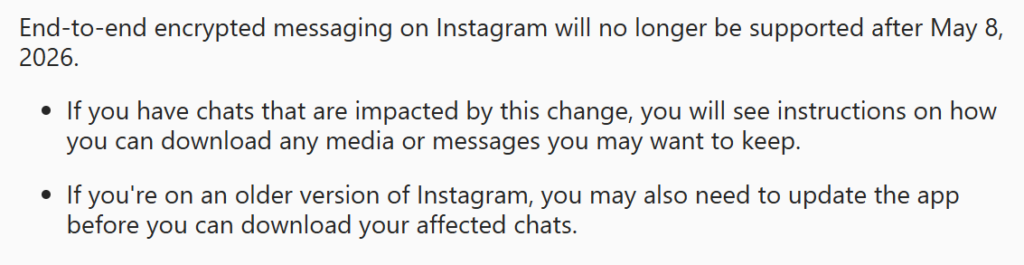
Meta is removing the ability to send end-to-end encrypted direct messages on Instagram. End-to-end encryption is a security method that ensures only the sender and recipient can read a message. Not Instagram, not Meta, and not any third party. Once this option is gone, messages sent through Instagram DMs will no longer have that protection by default or by choice.
The decision was first confirmed via Instagram’s Help Center and communicated to users through in-app pop-up notifications. According to Engadget, a Meta spokesperson stated that very few people were opting in to end-to-end encrypted messaging in DMs, and that the feature would be removed in the coming months. Meta has pointed users toward WhatsApp as an alternative, where E2EE is enabled by default for all conversations.
Which Instagram Users Are Affected?
This change affects any Instagram user who has been using the opt-in encrypted messaging feature. Unlike WhatsApp, Meta never made end-to-end encryption the default for Instagram. Instead, users in select regions were given the option to enable it on a per-chat basis. That option will no longer exist after May 8, 2026.
Anyone currently using encrypted Instagram chats will receive in-app notifications prompting them to download their messages and any shared media before the deadline, according to Cyber Security News. Meta hasn’t publicly clarified whether encrypted chats will be permanently deleted after the cutoff date, so users should act sooner rather than later.
When Is Instagram Encryption Being Removed?
Instagram end-to-end encryption will be removed on May 8, 2026. Meta first began testing E2EE for Instagram direct messages in 2021 as part of CEO Mark Zuckerberg’s stated “privacy-focused vision for social networking,” before formally rolling it out in late 2023 as an opt-in option in select regions. The Hacker News notes the removal deadline gives users a limited window to preserve any conversations they may want to keep.
Why Is Meta Removing Encryption From Instagram?
Meta’s stated reason is low adoption. The company says only a small fraction of Instagram users ever enabled encryption on their direct messages, making the feature too niche to maintain. According to Meta, the majority of users seeking encrypted private messaging already use WhatsApp, where the protection is built-in and on by default.
While that explanation is technically plausible, it has attracted significant scrutiny. As MediaNama points out, removing E2EE allows Meta to scan DMs for content moderation purposes, and governments in the US, UK, and EU have placed growing pressure on tech companies to detect harmful content in private messages. In March 2026, the European Parliament voted to extend a temporary exemption allowing online services to voluntarily detect child sexual abuse material until August 3, 2027, and that wider regulatory context may well have influenced Meta’s decision. Internal documents surfaced during a New Mexico child safety trial also show Meta executives debating the trade-offs between safety and privacy, with Zuckerberg testifying that safety concerns were a significant reason why bringing encryption to Messenger took so long.
What Removing Instagram Encryption Means for Your Privacy
Without end-to-end encryption, Instagram DMs will be accessible to Meta at the infrastructure level. Because E2EE prevents the company from accessing message contents, removing it means future messages will no longer carry that protection.
The advertising implications are particularly notable. In December 2025, Meta updated its privacy policy to confirm that interactions with its Meta AI tools, including those inside private conversations, may be used to personalize ads across Facebook, Instagram, and Messenger, as reported by PrivacyWire. Removing the last remaining encryption option from Instagram DMs opens the door to private messages being analyzed for advertising, used for AI training, or accessed in response to legal requests. Meta insists that Facebook Messenger will retain E2EE for personal one-on-one chats and that WhatsApp’s encryption is unaffected, but for Instagram specifically, the privacy door is closing.
Instagram Encryption and the Wider Privacy Debate
Meta’s decision didn’t happen in a vacuum. The announcement came roughly two weeks after TikTok stated it would not introduce end-to-end encryption for its own direct messages, citing concerns that the technology could limit TikTok’s ability to detect harmful content. Critics have pointed out that both justifications end in the same place, less message privacy for users.
This is part of a broader and ongoing tension between large tech companies and user privacy. The FBI and other law enforcement agencies have long argued that encryption creates obstacles to complying with warrants and detecting criminal activity, a debate they have formally labeled the “Going Dark” problem. The Electronic Frontier Foundation, on the other hand, argues that removing encryption puts ordinary users at far greater risk without meaningfully addressing criminal behavior, and that there’s no backdoor that works only for the “good guys.”
The Real Privacy and Security Risks of Unencrypted Instagram DMs
Once encryption is gone from Instagram DMs, the risks aren’t abstract. Private conversations that users believed were protected could become subject to data requests from law enforcement, accessible under future policy changes, or caught up in data breaches.
Instagram has already experienced significant security incidents. In early 2026, a dataset containing approximately 17.5 million Instagram user records appeared on a dark web forum, including usernames, email addresses, phone numbers, and partial physical addresses, as reported by PrivacyWire. The data is believed to have been harvested via an inadequately secured Instagram API during 2024. Meta denied a direct system breach, but security researchers noted that whether you call it a breach or scraping, the result for affected users is the same.
What Security Experts Are Saying About Meta’s Encryption Decision
The security and privacy research community hasn’t been quiet. Matthew Green, a cryptographer and professor at Johns Hopkins University, publicly stated that Meta appears to be reversing its previously strong stance on encryption. For a company that in 2019 positioned itself as moving toward a privacy-focused messaging future, this represents a clear step in the opposite direction. Privacy researchers have also warned that the combination of conversational AI and ad targeting creates new tools for extracting personal information from users who believe they’re in a private space.
How to Protect Your Instagram Privacy Before May 8, 2026
There are several practical steps worth taking now.
- Download your encrypted Instagram chats. Go to your Instagram settings and use the data download option to export your message history before the cutoff date.
- Review what you’ve sent. If your DMs contain anything sensitive or professionally significant, now is a good time to assess whether you’re comfortable with that content being accessible to Meta going forward.
- Consider switching to WhatsApp for conversations that require genuine privacy. It remains Meta’s own recommendation, and E2EE is on by default there.
- Delete old Instagram messages. If you’d rather not have years of unencrypted message history sitting on Meta’s servers, clearing it out in bulk is a sensible step.
- Review your Meta AI settings. You can adjust ad preferences in your account settings to limit some forms of personalization, though there’s no full opt-out from AI chat data being used for targeting.
Take Control of Your Instagram Data Before the Deadline
The removal of Instagram’s end-to-end encryption is a reminder that privacy features on commercial services aren’t permanent. They can be introduced, restricted, or removed entirely based on business decisions, and users are often the last to find out. What feels private today may not be protected tomorrow.
If you want to take action today, Redact lets you bulk delete Instagram messages, posts, and other content, along with dozens of other sites including Facebook, Twitter, Discord, and Reddit. Everything runs locally on your device, meaning your credentials and message content are never processed on external servers. Get started with Instagram deletion here and take back control of what you’ve shared before the May 8 deadline arrives.